
6CNC · Custom steel parts
1045 Carbon Steel
CNC Machining
Medium-carbon steel for shafts, pins, hubs, and loaded machine components
AISI 1045 is a medium-carbon steel that provides greater strength and hardness than low-carbon grades such as 1018 while remaining economical and widely available.
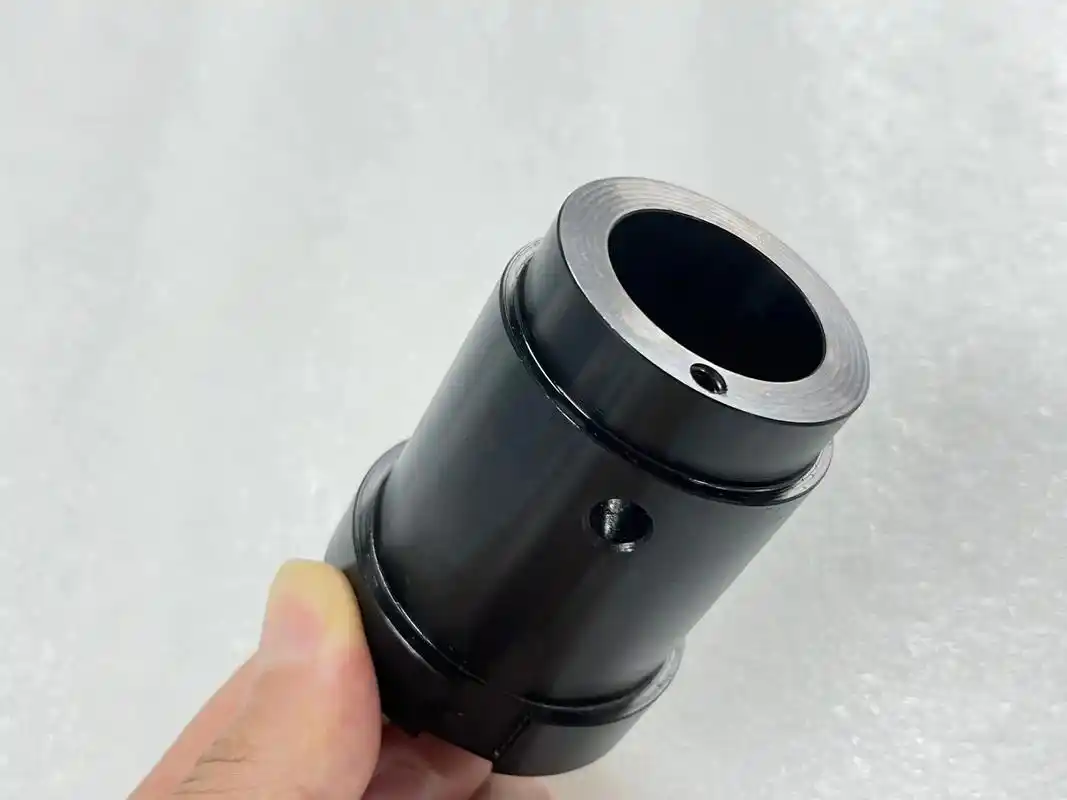
Custom 1045 Carbon Steel Parts with 6CNC
It is frequently used for shafts, pins, axles, hubs, rollers, machine components, couplings, gears, tooling, and fixtures.
1045 is a practical material when 1018 is too soft but alloy steel such as 4140 is unnecessary.
Material characteristics
1045 contains approximately 0.45% carbon.
Compared with 1018, the higher carbon level provides greater strength, hardness, wear resistance, and heat-treatment response, but lower weldability.
Representative properties vary significantly with normalized, annealed, cold-drawn, or heat-treated condition. The stock condition should therefore be stated when mechanical properties matter.
Material values are typical references, not design allowables. Confirm the governing specification, stock form, material certificate and heat-treatment condition for your part.
1045 machinability
1045 generally machines well in annealed or normalized conditions. It forms chips more readily than very low-carbon steel and can produce good turned surfaces.
Machining becomes more demanding after heat treatment. Actual hardness, tool material, cutting speed, workholding, coolant, interrupted cuts, and final surface requirement all affect the process.
Why 1045 is popular for shafts
1045 provides a useful balance of strength, cost, and machinability for rotational components.
Typical shaft features include bearing journals, keyways, threads, shoulders, retaining-ring grooves, cross-holes, splines, and tapers.
A shaft may require turning, milling, heat treatment, and cylindrical grinding. When bearing journals require very tight tolerance or low roughness, grinding is often the final process.
Heat treatment
1045 can be normalized, quenched and tempered, flame hardened, or induction hardened.
Induction hardening is especially useful for shafts and wear surfaces because selected regions can be hardened while retaining a tougher core.
Heat-treatment requirements should state target hardness, hardness range, hardened depth where applicable, areas to remain soft, and final dimensional requirements.
1045 vs. 1018
Choose 1045 when higher strength, wear resistance, or heat treatment is required. Choose 1018 when welding, low cost, formability, and moderate loading are more important.
1045 vs. 4140
4140 contains chromium and molybdenum and has much greater hardenability.
4140 is usually preferred when large section thickness must harden uniformly, fatigue strength is important, toughness at high strength is critical, or prehardened stock is desired.
1045 is often more economical for moderate-duty shafts, pins, hubs, and machine components.
Surface treatments
Common options include black oxide, zinc plating, nickel plating, phosphate, paint, powder coating, hard chrome for suitable shaft applications, and oil/rust preventative.
The finish should be coordinated with final fits and grinding operations.
Typical 1045 machined parts
- Drive shafts
- Axles
- Pins
- Hubs
- Rollers
- Couplings
- Gears
- Spindles
- Machine-tool components
- Jigs and fixtures
- Wear blocks
- Mechanical links
Quality considerations
For loaded parts, inspection may focus on diameter, runout, concentric relationships, keyway position, flatness, perpendicularity, thread quality, surface roughness, and hardness after heat treatment.
6CNC can support turning, milling, grinding, CMM inspection, and heat-treatment coordination.
Why 6CNC for 1045 steel?
6CNC supports CNC turning, CNC milling, mill-turn, heat treatment, cylindrical grinding, surface grinding, prototype/small-batch production, 9+ quality engineers, and 20+ inspection tools.
Send your 1045 drawing with material condition and hardness requirements.
1045 Steel CNC Machining FAQs
Is 1045 easy to machine?
Yes, in annealed or normalized conditions it has good machinability. Heat-treated 1045 requires more conservative cutting conditions or grinding.
Can 1045 be hardened?
Yes. It responds well to quench-and-temper, flame hardening, and induction hardening.
Is 1045 suitable for shafts?
Yes. It is widely used for shafts, pins, axles, rollers, and hubs.
Is 1045 weldable?
It can be welded, but weldability is lower than 1018 because of its higher carbon content.
Does 1045 rust?
Yes. It normally needs plating, coating, oil, or other corrosion protection.
Is 1045 the same as S45C?
They are comparable medium-carbon steel designations used under different standards, but substitution should follow the drawing and applicable specification rather than assuming perfect equivalence.
From Drawing to Finished Part
01
Share your files
Send your CAD model, controlled drawing, quantity and specified steel condition.
02
Confirm the route
Review stock, machining, heat treatment, finishing and inspection together.
03
Machine and finish
Produce the part to the agreed drawing, allowing for any heat-treatment movement.
04
Inspect and deliver
Verify the required dimensions and supply the agreed inspection documentation.
Compare Steel Grades
Also compare: Stainless Steel 304 · Stainless Steel 316 · 17-4 PH Stainless Steel · Stainless Steel 420 · 440C Stainless Steel
Start your project with 6CNC
Let’s review your 1045 Carbon Steel part.
Share the drawing and service conditions for a project-specific machining and quotation review.
Include with your enquiry
- 3D CAD and controlled PDF drawing
- Steel grade, stock condition and applicable specification
- Quantity and delivery target
- Heat treatment, hardness and critical dimensions
- Surface finish and inspection requirements