Low-volume CNC machining sits in one of the most important stages of modern product development: the point where a design has moved beyond a one-off prototype but is not yet ready—or may never need—to enter mass production.
A company may need 10 aluminum housings for engineering validation, 50 stainless steel brackets for a pilot machine build, 200 PEEK components for a medical-device development program, or 500 robotic parts for an initial commercial release. In all of these cases, the requirement is no longer simply to prove that one part can be manufactured. The process also needs to produce multiple parts with repeatable dimensions, controlled quality, and reasonable cost without committing to expensive molds, dies, or high-volume automation. For examples of how materials, sealing interfaces and inspection shape the process, read our guide to CNC machining in the energy industry.
That is where low-volume CNC machining becomes valuable.
Unlike tooling-intensive processes, CNC machining can move directly from CAD data and drawings into production-grade metal or plastic parts. Design changes can be incorporated quickly, quantities can increase gradually, and the same manufacturing route can support prototypes, engineering builds, bridge production, replacement parts, and recurring small-batch orders.
But low-volume machining should not be confused with simply making “a few CNC parts.” Once quantity increases beyond prototypes, fixture design, tool life, process control, inspection frequency, revision management, and repeatability become increasingly important.
This guide explains what low-volume CNC machining actually means, where it fits between prototyping and mass production, how quantity changes the manufacturing strategy, what drives cost, and when CNC machining is the right production process.
What Is Low-Volume CNC Machining?
Low-volume CNC machining refers to producing relatively small quantities of machined parts using CNC milling, turning, 5-axis machining, mill-turn, grinding, EDM, or related manufacturing processes.
There is no universal quantity that defines “low volume.”
For one project, 20 parts may be a production batch. For another, 500 pieces may still be considered low volume because the component is highly specialized or annual demand is limited.
In practical custom manufacturing, low-volume CNC production often covers quantities from a few parts to several hundred pieces per order, although the most economical range depends strongly on part geometry, size, material, tolerance, cycle time, and repeat frequency.
The important distinction is not the exact number.
It is the manufacturing approach.
A one-off prototype can tolerate more manual adjustment because only one or two components need to be completed. A recurring batch of 100 parts requires a more controlled process because every setup, tool offset, and inspection method must remain repeatable across the full order.
Low-volume CNC machining therefore sits between:
Prototype machining → Low-volume / small-batch production → Full production
Each stage uses CNC equipment, but the production priorities are different.
Prototype CNC Machining vs Low-Volume CNC Production
Prototype machining is mainly about learning.
The engineering team may need to confirm:
- whether components fit together;
- whether a tolerance is realistic;
- whether a housing clears nearby hardware;
- whether the selected material is strong enough;
- whether the design functions as expected.
If only one or two parts are required, a machinist can sometimes use temporary fixtures, manual measurement, or additional setup time that would not make sense in a production batch.
Low-volume production changes the objective.
Now the process must answer another question:
Can the same part be produced repeatedly without excessive adjustment?
Imagine that a robotics company orders two prototype 7075 aluminum joint housings.
The machinist may spend extra time indicating each blank, adjusting offsets, and verifying individual bearing bores.
If the project then moves to 150 housings, repeating those manual steps 150 times would be inefficient and introduce too much variation.
The supplier may now need:
- dedicated soft jaws;
- reusable locating features;
- probing routines;
- controlled tool-life limits;
- first article inspection;
- periodic dimensional checks;
- standardized work instructions.
The CAD model may be unchanged, but the manufacturing process has matured.
That is one of the defining differences between prototyping and low-volume CNC production.
What Quantities Make Sense for Low-Volume CNC Machining?
There is no single break-even quantity, but quantity strongly influences how the machining process is planned.
A useful way to think about low-volume CNC machining is by production stage rather than using one fixed numerical definition.
| Typical quantity | Common use | Manufacturing priority |
|---|---|---|
| 1–5 parts | Prototype / proof of concept | Speed and design validation |
| 5–20 parts | Engineering test build | Function and repeatability |
| 20–100 parts | Pilot / pre-production batch | Process stability and inspection |
| 100–300 parts | Small-batch production | Fixture efficiency and tool-life control |
| 300–600+ parts | Repeated low-volume production | Cycle-time optimization and process control |
These ranges are not strict boundaries.
A large titanium aerospace component with a long cycle time may remain economical at quantities far below 100 pieces. A simple aluminum bracket might be efficiently machined in quantities well above 600.
Part complexity matters more than the number alone.
The important point is that manufacturing strategy should evolve as quantity increases.
Where Low-Volume CNC Machining Fits in the Product Lifecycle
Low-volume CNC production can support several different stages rather than serving only as a transition between prototype and mass production.
Engineering Validation
Early development often needs real engineering materials.
A 3D-printed plastic model may confirm basic geometry, but it cannot necessarily replicate the stiffness, heat resistance, thread strength, wear, or surface characteristics of the final metal component.
CNC machining can produce parts from the intended material so engineers can test real mechanical behavior.
An automation company, for example, may machine 10 stainless steel shafts and aluminum housings to test bearing fit and assembly alignment under actual operating loads.
Design Verification and Validation
Once the basic design works, teams often need larger batches.
Medical devices, robotics systems, optical instruments, industrial equipment, and electronics may require dozens of assemblies for testing.
At this stage, variation between parts becomes important.
If 30 test units behave differently because machined components vary excessively, engineers may be unable to determine whether a failure comes from the product design or manufacturing inconsistency.
Low-volume CNC production therefore begins to require production-level discipline.
Pilot Production
A pilot batch allows a company to test manufacturing, assembly, packaging, customer response, and field performance before increasing volume.
For example, a robotics manufacturer may initially release 100 systems to selected customers.
Machining the structural components avoids investing in expensive dedicated tooling before real-world demand and design stability have been confirmed.
Bridge Production
Bridge production is especially valuable when the long-term manufacturing process is not yet ready.
Suppose a plastic housing will eventually be injection molded, but mold development requires several weeks.
Instead of delaying the complete product launch, the first 100 or 200 housings may be CNC machined while mold tooling is being completed.
CNC machining effectively bridges the gap between development and mass production.
End-Use Low-Volume Production
Not every component eventually reaches high volume.
Specialized medical equipment, optical systems, industrial automation, scientific instruments, marine systems, aerospace hardware, and custom machinery may remain in quantities of tens or hundreds per year.
For these products, CNC machining may remain the final production process throughout the entire product lifecycle.
Why Low-Volume CNC Machining Is So Useful
The main advantage is flexibility without giving up production-grade materials or dimensional control.
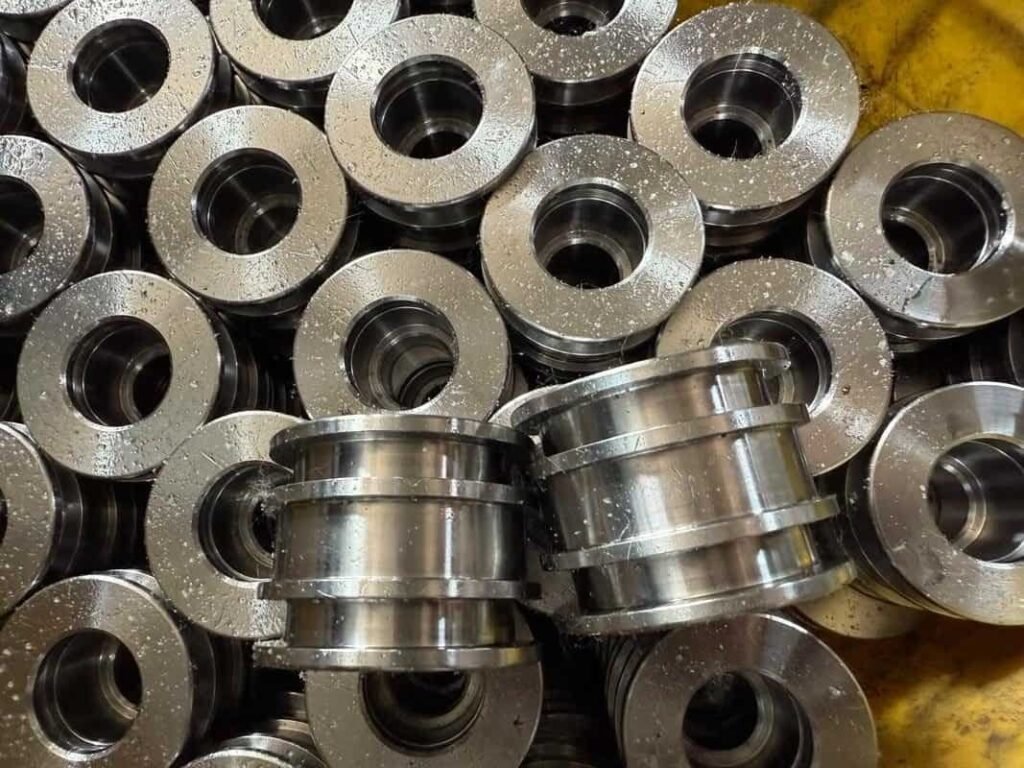
No Dedicated Mold or Die Is Required
CNC machining uses programmable machine motion rather than product-specific molding tooling.
Changing a feature may require a new CAM program or fixture modification, but usually does not require manufacturing a completely new injection mold or die.
This reduces the financial risk of early design decisions.
If testing shows that a mounting hole needs to move 2 mm, the CAD model and program can be updated relatively quickly.
Production Materials Can Be Used Immediately
Parts can be manufactured from aluminum, stainless steel, titanium, copper, brass, engineering plastics, and many other final-use materials.
This allows engineering teams to validate real product behavior earlier.
Quantities Can Increase Gradually
Instead of jumping directly from 5 prototypes to 5,000 production parts, companies can scale gradually.
A project may progress like this:
5 prototypes → 30 validation parts → 100 pilot parts → 300 launch parts
This gives engineering and procurement teams more opportunities to learn before committing capital.
Revision Risk Is Lower
Early products change.
Even well-developed components may need modifications after assembly, endurance testing, regulatory review, customer feedback, or field use.
Low-volume CNC production makes those revisions easier to absorb.
Low-Volume CNC Machining Is Not Just “Prototype Machining at Higher Quantity”
This is one of the most important distinctions.
Once quantities rise, the production process should become more systematic.
Consider a machined aluminum optical housing produced in batches of 100.
The component contains:
- a precision lens bore;
- several threaded mounting holes;
- an optical reference face;
- an external cosmetic surface.
If the first part is machined successfully, that does not guarantee the remaining 99 parts will match it.
During the batch:
- cutting tools wear;
- fixtures accumulate chips;
- temperature changes;
- operators replace tools;
- material stock varies;
- offsets are adjusted.
Low-volume production therefore requires a process capable of managing those variables.
The manufacturing challenge becomes repeatability rather than simply feasibility.
Fixture Strategy Changes With Quantity
Workholding is one of the biggest differences between prototype and small-batch machining.
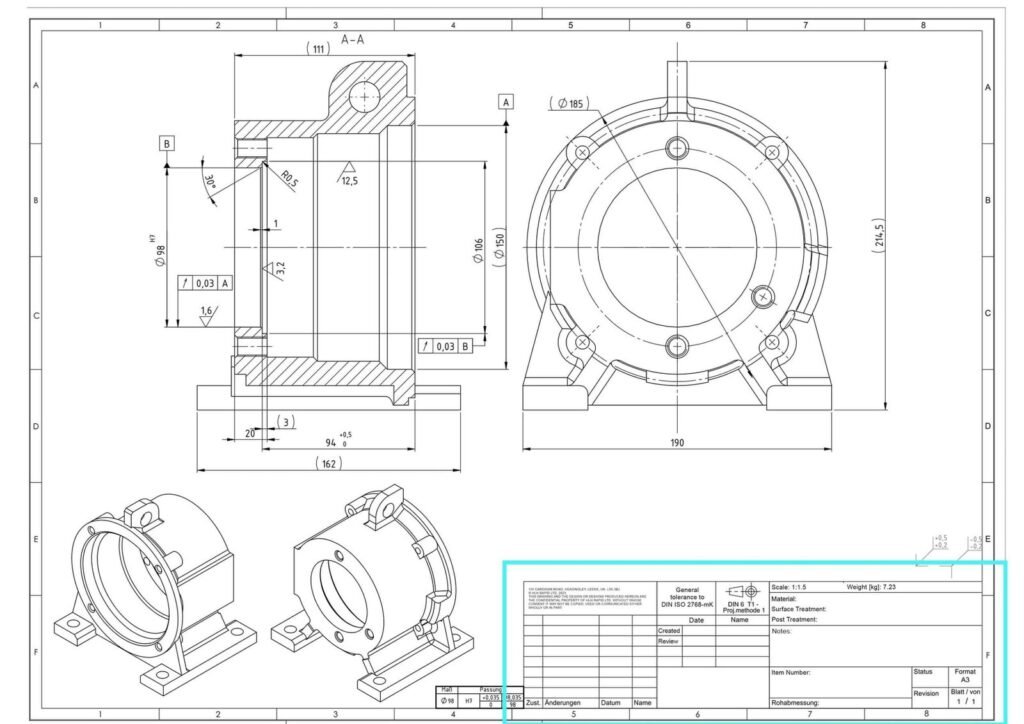
For a quantity of one, a general-purpose vise or temporary fixture may be sufficient.
As quantities increase, setup time becomes increasingly important.
Imagine that loading and aligning one component takes eight minutes.
For two prototypes, that represents only sixteen minutes.
For 200 parts, the same setup method would consume more than 26 hours before machining time is even considered.
A dedicated fixture or set of machined soft jaws might reduce loading to two minutes.
Although the fixture requires additional engineering and manufacturing effort initially, that investment becomes worthwhile as quantity increases.
Good low-volume fixtures should balance cost and flexibility
Unlike mass production, low-volume manufacturing usually cannot justify extremely expensive hard tooling.
Fixtures may therefore use:
- machined soft jaws;
- modular fixture plates;
- locating pins;
- zero-point systems;
- vacuum workholding;
- reusable tombstones;
- 4-axis or 5-axis workholding.
The goal is not maximum automation.
It is repeatable location without excessive tooling cost.
Why 5-Axis Machining Can Be Valuable in Small Batches
Five-axis machining is sometimes associated only with extremely complex aerospace parts, but it can also improve low-volume economics.
A complicated housing may require four or five separate setups on a 3-axis machine.
If only 30 pieces are required, manufacturing five dedicated fixtures may not make economic sense.
A 5-axis machine may allow most features to be completed in one or two setups using simpler workholding.
Even if the five-axis machine has a higher hourly cost, the total manufacturing cost may be lower because:
- fewer fixtures are needed;
- setup time decreases;
- manual handling decreases;
- datum-transfer risk is reduced;
- inspection becomes simpler.
This is especially relevant for low-volume multi-face components.
Materials for Low-Volume CNC Production
One of the strongest advantages of CNC machining is material flexibility.
The same general manufacturing method can process a wide variety of production-grade materials without dedicated molds.
Aluminum
Aluminum is one of the most common choices for low-volume production because it combines good machinability, low density, corrosion resistance, and useful strength.
Common examples include:
- 6061;
- 7075;
- 2024;
- 5052.
Typical applications include robotic housings, optical equipment, electronics, fixtures, aerospace components, and automation systems.
Stainless Steel
Stainless steels such as 304, 316, 17-4PH, and 416 are used where corrosion resistance, strength, hygiene, or wear resistance matter.
Low-volume examples include:
- medical equipment;
- fluid components;
- shafts;
- valves;
- brackets;
- industrial hardware.
Titanium
Titanium is more expensive and more difficult to machine, but CNC production remains attractive for low quantities because casting or forging tooling may not be economical.
Typical applications include medical, aerospace, marine, and high-performance equipment.
Engineering Plastics
PEEK, POM/Delrin, PTFE, nylon, PC, and other engineering plastics are commonly machined for:
- electrical isolation;
- low-friction parts;
- medical equipment;
- semiconductor applications;
- fixtures;
- prototypes;
- low-volume end-use components.
Machining engineering plastics also avoids injection mold investment when quantities remain limited.
Tolerance Strategy Matters More as Quantity Increases
Tight tolerances are possible in low-volume CNC machining, but they should be applied where function requires them.
Over-tolerancing becomes increasingly expensive as quantity rises because each additional requirement may affect:
- machining cycle time;
- tool selection;
- finishing operations;
- inspection frequency;
- scrap risk.
Consider a housing containing one precision bearing bore.
If the bore requires a tight fit but the external profile does not, applying the same tolerance level to the entire component creates unnecessary work.
A better drawing defines precision according to function.
For example:
- bearing bore: tightly controlled;
- datum face: controlled flatness;
- hole pattern: true-position requirement;
- external cosmetic profile: general machining tolerance.
This allows the manufacturing process to focus effort where it creates actual product value.
First Article Inspection Becomes Important
Before producing the complete batch, the first finished part should confirm that the process is working.
First Article Inspection can verify:
- critical dimensions;
- datums;
- GD&T
- material;
- surface requirements;
- threads;
- mating features.
Suppose a 100-piece order contains a critical ±0.015 mm bearing bore.
It makes little sense to machine all 100 components before confirming that the setup produces the bore correctly.
The first article gives engineering and quality teams an early checkpoint.
Once the process is approved, production can continue with periodic inspections based on feature criticality and process stability.
In-Process Inspection Helps Prevent Batch-Wide Scrap
Final inspection tells you whether a finished part passes.
In-process inspection tells you whether the process is starting to drift.
That distinction becomes important in low-volume production.
Imagine a cutter gradually wearing while machining 200 aluminum housings.
If a critical pocket width drifts by only a few microns per part, the first 50 components may remain comfortably inside tolerance.
Later parts may approach the specification limit.
If inspection occurs only after all 200 are complete, the problem is discovered too late.
Periodic measurement allows the manufacturing team to identify the trend and adjust the process earlier.
Useful production-control methods may include:
- machine probing;
- CMM inspection;
- bore gauges;
- micrometers;
- pin gauges;
- optical measurement;
- surface roughness testing.
Not every dimension needs the same inspection frequency.
Critical and wear-sensitive features deserve the most attention.
Tool-Life Management Matters More Than People Expect
Tooling may have very little influence on a batch of two parts.
It can become one of the main variables in a batch of 300.
Cutting edges gradually wear during machining.
That wear can affect:
- diameter;
- wall position;
- bore size;
- surface finish;
- burr formation.
For repeatable small-batch production, the machining team may establish expected tool-life limits.
A finishing tool can be replaced after a defined number of components rather than waiting for it to fail or visibly damage a part.
This is particularly useful for stainless steel, titanium, hardened materials, and tight-tolerance features.
Low-Volume CNC Cost: What Actually Drives the Price?
Low-volume CNC cost is often misunderstood because buyers focus primarily on machine cycle time.
Actual cost usually includes several categories.
Programming
CAM programming and manufacturing planning are often fixed costs.
A complicated five-axis component may require several hours of programming regardless of whether the quantity is 2 or 100.
As quantity increases, that programming cost is distributed across more parts.
Setup
Fixtures must be installed, tools loaded, work offsets established, and the first part verified.
Setup is another cost that can be distributed across the batch.
Machining Time
This is the variable portion most people expect.
A part requiring 45 minutes of spindle time will naturally cost more than a component requiring eight minutes.
Material
Material cost can become substantial for:
- titanium;
- copper;
- large aluminum billets;
- engineering plastics such as PEEK.
Material utilization therefore matters.
Cutting Tools
Difficult materials and long production runs increase tooling consumption.
Inspection
A part requiring a detailed CMM report costs more to inspect than a general-tolerance bracket checked using normal shop-floor measurement.
Secondary Processing
Anodizing, passivation, plating, heat treatment, grinding, laser marking, assembly, and other services also influence final price.
Why Unit Cost Usually Drops as Quantity Increases
For a simplified cost illustration—not a quotation—suppose a part requires:
- $300 of programming and setup;
- $40 of machining/material cost per part.
For one part, the total might effectively be $340.
For ten parts, the $300 fixed cost is spread across the batch.
The average setup contribution becomes $30 per part.
At 100 pieces, it becomes only $3 per part.
This is why CNC quotations often show meaningful price breaks between:
- 1 piece;
- 10 pieces;
- 50 pieces;
- 100 pieces.
However, the reduction does not continue indefinitely at the same rate.
Eventually, machine cycle time, material, tools, inspection, and secondary operations dominate the price.
At sufficiently high quantities, another process may become more economical.
When CNC Machining Beats Injection Molding
For plastic parts, one of the most common decisions is whether to continue machining or move to injection molding.
CNC machining usually has:
- little or no dedicated tooling investment;
- faster initial production;
- easy design revisions;
- relatively high unit cost.
Injection molding has:
- significant tooling cost;
- longer setup before production;
- very low unit cost at high volume.
Imagine a POM component required in quantities of 50.
Machining may be substantially more economical because a mold cannot be justified.
At 50,000 pieces per year, injection molding may become the obvious production choice.
Between those extremes is a transition region where the answer depends on part size, complexity, material, mold cost, machining time, and expected design stability.
There is no universal quantity where injection molding automatically becomes cheaper.
When CNC Machining Beats Die Casting
A similar comparison applies to metal parts.
Die casting can produce complex aluminum or zinc components efficiently at high volumes, but it requires dedicated tooling.
CNC machining is often more appropriate when:
- quantities are low;
- design changes are likely;
- tighter machining tolerances are required;
- wrought material properties are preferred;
- launch speed matters.
At higher volume, die casting plus finish machining may provide better economics.
Some components therefore transition from:
CNC-machined billet → Die-cast near-net blank + finish machining
as volume increases.
CNC Machining vs 3D Printing for Low Quantities
For very low volumes, 3D printing may also compete with CNC machining.
Additive manufacturing is especially attractive for:
- highly complex internal geometry;
- lightweight lattice structures;
- fast concept iteration;
- geometry that is difficult to reach with cutting tools.
CNC machining is generally stronger for:
- tighter tolerances;
- precision bores;
- machined sealing faces;
- smooth surfaces;
- wrought material properties;
- conventional engineering metals.
A product may use both.
For example, a robotic assembly could contain a CNC-machined aluminum structural frame and 3D-printed polymer cable guides.
The best manufacturing process should be selected part by part.
Low-Volume Machining for Robotics
Robotics is a strong example of where small-batch CNC manufacturing makes sense.
Robot designs evolve quickly, but many structural components require real engineering materials and precision fits.
Common parts include:
- joint housings;
- motor mounts;
- bearing housings;
- shafts;
- brackets;
- end-effector components;
- sensor mounts.
A robotics company may initially require 10 complete systems, then 50, then 200.
CNC machining allows the mechanical design to evolve through these production stages without forcing an early commitment to dedicated tooling.
Bearing interfaces, motor alignment, gearbox mounting, and structural stiffness can also be validated using the same materials intended for production.
Low-Volume CNC Machining for Medical Devices
Medical-device programs often involve relatively low volumes combined with demanding documentation and precision requirements.
Typical machined components include:
- surgical instrument parts;
- diagnostic equipment housings;
- fixtures;
- robotic medical components;
- precision connectors;
- PEEK components;
- stainless or titanium hardware.
These projects may require more than dimensional compliance.
Material traceability, inspection reports, revision control, surface requirements, and documented processes can also become important.
This is why low-volume medical manufacturing should not be approached like ordinary one-off prototyping.
Low-Volume CNC Machining for Optical Equipment
Optical systems frequently require relatively small quantities of precision components.
Examples include:
- lens mounts;
- optical housings;
- alignment stages;
- frames;
- mirror mounts;
- instrument structures.
The total batch may be only 20–100 pieces, but geometric relationships can be critical.
Bore position, perpendicularity, flatness, and mounting references may influence optical alignment.
CNC machining is well suited to these applications because it combines low tooling requirements with precise geometric control.
Low-Volume CNC Machining for Industrial Automation
Custom machinery and automation equipment rarely require consumer-product quantities.
A machine builder may need:
- 12 fixture plates;
- 30 actuator housings;
- 50 custom brackets;
- several replacement shafts.
Even after the machine enters service, spare components may be required periodically.
CNC machining supports this production model well because digital part data can be retained and reused for future batches.
Why Repeat Orders Need Revision Control
Low-volume production often happens in multiple releases.
A customer might order:
- 20 parts in January;
- 50 revised parts in March;
- 100 parts in July.
The challenge is ensuring that the correct revision is manufactured every time.
A supplier should therefore control:
- drawing revision;
- CAD version;
- manufacturing instructions;
- inspection criteria;
- approved deviations.
Producing a dimensionally perfect part from an obsolete drawing is still a manufacturing failure.
Revision control becomes particularly important as development programs evolve quickly.
How to Design Parts for Lower Low-Volume CNC Cost
Design for Manufacturability can reduce cost without compromising function.
Avoid unnecessary tight tolerances
Apply tight tolerances only to functional dimensions.
Increase internal corner radii where possible
Small internal radii require smaller cutters.
Smaller cutters are generally less rigid and slower.
Avoid unnecessarily deep pockets
Deep pockets increase tool length, cycle time, and chatter risk.
Keep wall thickness practical
Extremely thin walls require lighter machining and more careful workholding.
Standardize hole and thread sizes
Standard tooling is generally more economical than unusual dimensions.
Design with practical tool access
A feature that requires a special setup or custom tool can add significant cost to a low-volume batch.
These changes can matter more economically at 100 pieces than at one prototype because every unnecessary machining second or inspection requirement is repeated across the complete batch.
Should Low-Volume Parts Be Designed for Future Mass Production?
Sometimes yes.
If the project is expected to transition into casting or injection molding, the engineering team should consider the future process early.
However, prototype and low-volume parts do not always need to imitate every limitation of the final manufacturing method.
The better approach is to separate two goals:
What must be representative for engineering validation?
and
What needs to be redesigned later for mass-production economics?
For example, a CNC-machined plastic enclosure can validate size, assembly, button placement, and electronics integration before draft angles and molding-specific details are finalized.
This allows product development to continue without prematurely locking the design into expensive tooling.
When Low-Volume CNC Machining Is Not the Best Choice
CNC machining is not always the correct solution.
Another process may be better when:
- annual volume is very high;
- material utilization is extremely poor;
- the part contains complex internal passages impossible to machine;
- sheet metal fabrication better matches the geometry;
- the product is a thin molded plastic shell;
- casting provides much better economics at scale.
The objective should not be to force every project into CNC machining.
The best process is the one that meets the required:
- quantity;
- material;
- geometry;
- tolerance;
- lead time;
- total cost.
Choosing a Low-Volume CNC Machining Supplier
When the production plan is clear, evaluate quotations and acceptance conditions separately. Use our CNC supplier purchasing guide for RFQ documents, supplier checks, first-article approval and delivery terms.
Example: From 5 Prototypes to 300 Robotic Housings
Consider a startup developing a robotic joint.
The housing is machined from 7075 aluminum and contains:
- two precision bearing bores;
- motor mounting features;
- threaded holes;
- cable channels;
- a curved exterior profile.
Stage 1: Five Prototypes
The first five parts are used for assembly and mechanical testing.
The priority is speed.
Soft jaws and standard inspection may be sufficient.
Testing reveals that one connector opening needs to move 3 mm.
The CAD model is updated without any hard tooling loss.
Stage 2: Thirty Validation Parts
The next batch is used in complete robot assemblies.
The two bearing bores now receive greater inspection attention because alignment variation could influence gearbox performance.
A repeatable fixture is developed.
Stage 3: One Hundred Pilot Parts
Now setup time and tool life become more important.
The machining process may be moved toward more efficient multi-part fixturing.
Critical dimensions are checked during the production run rather than only at the end.
Stage 4: Three Hundred Production Parts
The design is now stable.
Cycle-time improvements become more valuable.
Tool changes, fixture loading, inspection intervals, and production documentation are standardized.
The same component has remained CNC machined throughout the process, but the manufacturing strategy has changed dramatically as quantity increased.
That is what low-volume CNC production really means.
Low-Volume CNC Machining Cost vs Production Risk
A useful sourcing decision should consider more than unit price.
Suppose Supplier A quotes $42 per component while Supplier B quotes $47.
The lower quote may look preferable.
But if Supplier B provides more stable fixtures, First Article Inspection, better revision control, and faster engineering communication, the extra $5 can be insignificant compared with the cost of receiving 100 incorrect parts.
Low-volume manufacturing is often closely tied to product development, where schedule delays and failed test builds can be much more expensive than the machining price itself.
A better cost comparison includes:
- part price;
- tooling cost;
- engineering time;
- inspection;
- lead time;
- scrap risk;
- revision flexibility;
- inventory risk.
Low-Volume CNC Machining Checklist
Before sending a small-batch CNC project for quotation, define the following:
| Requirement | What to specify |
|---|---|
| CAD data | STEP or other usable 3D model |
| Drawing | Critical dimensions, GD&T and notes |
| Material | Exact alloy or polymer grade |
| Quantity | Current batch and expected future quantities |
| Surface finish | Cosmetic and functional requirements |
| Post-processing | Anodizing, plating, heat treatment, passivation, etc. |
| Inspection | FAI, CMM report, critical dimensions |
| Revision | Current approved drawing/CAD revision |
| Functional features | Fits, sealing surfaces, bearing interfaces, alignment features |
| Future production | Whether quantity is expected to increase |
Providing future quantity estimates is particularly helpful.
A supplier may choose a different fixture strategy for 20 parts if they know another 300 pieces are likely to follow.
How 6CNC Approaches Low-Volume CNC Machining
At 6CNC, low-volume CNC projects are planned as a manufacturing progression rather than treating every order as a one-off prototype.
The initial review considers:
- geometry;
- material;
- tolerance;
- quantity;
- machining process;
- workholding;
- inspection requirements;
- expected future volume.
Depending on the part, production can involve CNC milling, CNC turning, 5-axis machining, mill-turn machining, precision grinding, Wire EDM, or complementary manufacturing processes.
For early prototypes, the priority may be rapid feedback and design validation.
As the project moves into small-batch production, the process can evolve toward more repeatable fixtures, controlled tool life, First Article Inspection, in-process measurement, and documented quality control.
6CNC supports custom precision parts from prototype into small-batch production, including projects in robotics, medical devices, optical equipment, aerospace, semiconductor equipment, automation, energy, automotive, marine, and other engineering applications.
The objective is not simply to manufacture a small number of parts.
It is to provide a production route that remains practical while the design, quantity, and commercial requirements continue to evolve.
Final Thoughts
Low-volume CNC machining fills the gap between prototype development and mass production, but its value goes far beyond avoiding tooling.
It allows companies to manufacture real production-grade components while they are still learning.
Designs can change.
Quantities can increase gradually.
Materials and tolerances can be validated under real conditions.
Engineering teams can move from one prototype into dozens or hundreds of components without immediately committing to a high-volume production method.
As quantity increases, however, the machining strategy must mature.
Fixtures become more important. Tool life matters. Inspection needs to move into the process. Revision control becomes essential. The goal changes from making one good component to maintaining a stable production method across the complete batch.
That is why low-volume CNC machining should be viewed as a production discipline in its own right—not simply a larger prototype order.
If you are developing a component that needs to move from prototype into quantities of tens or hundreds, send 6CNC your CAD files, engineering drawings, material requirements, current quantity, and expected future demand.
Our team can review the part and recommend a practical machining route for prototype and small-batch production.
Upload Your CAD Files → Request a Low-Volume CNC Machining Quote
Frequently Asked Questions
What is considered low-volume CNC machining?
There is no universal quantity. Low-volume CNC machining commonly covers anything from a few parts to several hundred pieces per batch, depending on part complexity, material, cycle time, and annual demand.
What is the difference between prototype machining and low-volume CNC production?
Prototype machining focuses on proving a design or function. Low-volume production additionally requires repeatable workholding, process control, tool-life management, and consistent inspection across multiple parts.
How many CNC parts should I order at once?
The ideal batch size depends on setup cost, future demand, revision risk, inventory requirements, and unit price. When the design is still changing, smaller staged orders can reduce risk.
Does CNC machining get cheaper at higher quantities?
Usually yes. Programming, setup, and fixture costs are distributed across more parts, reducing average unit cost. Eventually, however, machine time, material, tooling, and inspection establish a cost floor.
When should I switch from CNC machining to injection molding?
Injection molding becomes more attractive when plastic part volume is high enough to justify mold tooling and the design is stable. There is no universal quantity threshold because part size, complexity, material, mold cost, and machining time all influence the break-even point.
Is low-volume CNC machining suitable for end-use parts?
Yes. Many industrial, medical, robotics, aerospace, optical, and automation components remain CNC machined throughout their production life because annual quantities never justify dedicated high-volume tooling.
What materials can be used for low-volume CNC production?
Common materials include aluminum, stainless steel, titanium, carbon and alloy steels, brass, copper, PEEK, POM/Delrin, nylon, PTFE, polycarbonate, and many other engineering plastics.
Why is First Article Inspection useful for low-volume CNC machining?
FAI confirms that the machining setup, tooling, program, and inspection method can produce a conforming part before the complete batch is released.
Can low-volume CNC machining support repeat orders?
Yes. Repeat orders are common. Stable fixtures, controlled manufacturing instructions, revision management, and documented inspection help maintain consistency between production batches.
Is 5-axis machining useful for low-volume production?
Yes. Five-axis machining can reduce setups and dedicated fixture requirements on complex multi-face parts, making it particularly valuable when quantities are too low to justify elaborate production tooling.
What should I send for a low-volume CNC quotation?
Provide the 3D CAD model, engineering drawing, material, current quantity, expected future quantity, surface requirements, secondary processes, tolerances, GD&T, and inspection requirements.