
6CNC · Aluminum 6061
Aluminum 6061
CNC Machining
A practical first choice for custom machined aluminum parts
Aluminum 6061 is one of the most widely used alloys for CNC-machined components because it balances machinability, strength, corrosion resistance, availability, and finishing performance.
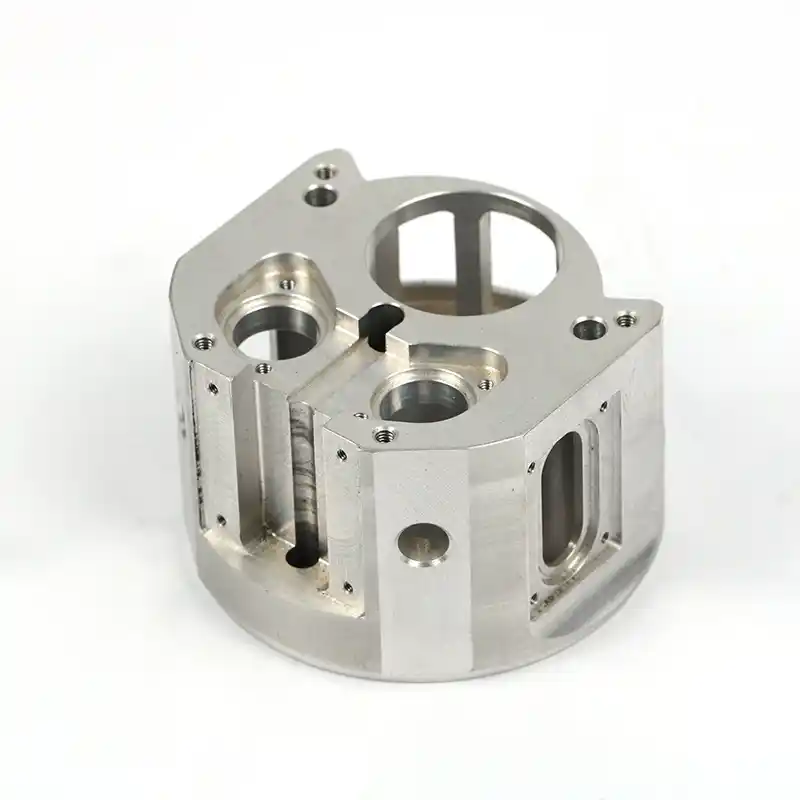
Representative geometry. Alloy and temper are confirmed from your specification.
Custom 6061 Parts with 6CNC
For many housings, brackets, fixtures, plates, covers, manifolds, electronic components, automation parts, and general mechanical assemblies, 6061 is the material engineers evaluate first. It machines efficiently, is available in a broad range of bar and plate sizes, responds well to anodizing, and offers enough strength for a large percentage of structural and functional parts.
6CNC machines custom Aluminum 6061 parts from prototype quantities through small-batch production. We support CNC milling, CNC turning, multi-axis machining, secondary operations, surface finishing, and dimensional inspection for parts that need reliable geometry rather than commodity machining.
Typical 6CNC fit
- Prototypes and engineering validation parts
- Low-volume and small-batch production
- Complex milled housings and brackets
- Turned and mill-turn components
- Tight-tolerance bores, pockets, datum features, and mounting interfaces
- Anodized cosmetic or functional aluminum parts
- Parts requiring CMM or documented dimensional inspection
Why engineers use 6061-T6 for CNC machining
6061 is an aluminum-magnesium-silicon alloy. In the T6 condition, it has been solution heat treated and artificially aged to improve strength. T651 material receives an additional stress-relief step, making plate stock especially useful where dimensional stability matters after significant material removal.
For CNC machining, the alloy is attractive because it does not force a major compromise in any one area. It is stronger than many non-heat-treatable aluminum grades, easier to source and machine than many aerospace-strength alloys, and more corrosion resistant than copper-rich 2xxx alloys.
Typical properties of Aluminum 6061-T6
| Property | Typical value |
|---|---|
| Density | 2.70 g/cm³ |
| Ultimate tensile strength | ~310 MPa |
| Yield strength | ~276 MPa |
| Elastic modulus | ~68.9 GPa |
| Brinell hardness | ~95 HB |
| Elongation | ~12–17%, depending on product form |
| Thermal conductivity | ~167 W/m·K |
| General machinability | Good |
Values are typical reference values for 6061-T6/T651 and can vary with product form, thickness, specification, supplier, and temper. Design decisions should use the governing material specification for the purchased stock.
Technical reference: ASM / MatWeb 6061 material data. Values depend on temper, product form, thickness and test conditions; use the purchased stock certification and governing specification for design.
6061-T6 vs. 6061-T651 for machined parts
The two tempers are closely related, but the distinction can matter on precision components.
6061-T6 is commonly supplied as bar, extrusion, tube, and other wrought forms. It is suitable for a wide range of turned and milled components.
6061-T651 is especially common in plate. After T6 heat treatment, the material is mechanically stress relieved. For larger plates, thin-wall housings, frames, instrument bases, and parts with deep material removal on one side, T651 is often preferred because reduced residual stress can help limit movement during machining.
For geometry where flatness, parallelism, wall straightness, or post-machining stability is critical, stock form and temper should be considered before machining begins rather than after a distortion problem appears.
How 6061 behaves during machining
6061 has good chip-forming behavior compared with softer, more gummy aluminum grades. It supports high spindle speeds, productive feed rates, and clean milling or turning when the toolpath, cutter geometry, workholding, and coolant strategy are appropriate.
The machining challenge is usually not “can 6061 be cut?” but “can the part remain dimensionally stable while material is removed?”
Large pockets, thin floors, thin walls, asymmetric stock removal, and long unsupported features can release residual stress or allow the part to deflect under cutting and clamping loads.
For precision 6061 parts, 6CNC can plan machining around:
- Balanced roughing from opposing faces
- Roughing and finishing in separate stages
- Appropriate stock allowance for final passes
- Low-force finishing near thin walls
- Controlled clamping on critical surfaces
- Reorientation to establish reliable datums
- Final inspection after the part is fully released from machining stress
This is especially important for enclosure bodies, optical mounts, robotics frames, inspection fixtures, and long flat components.
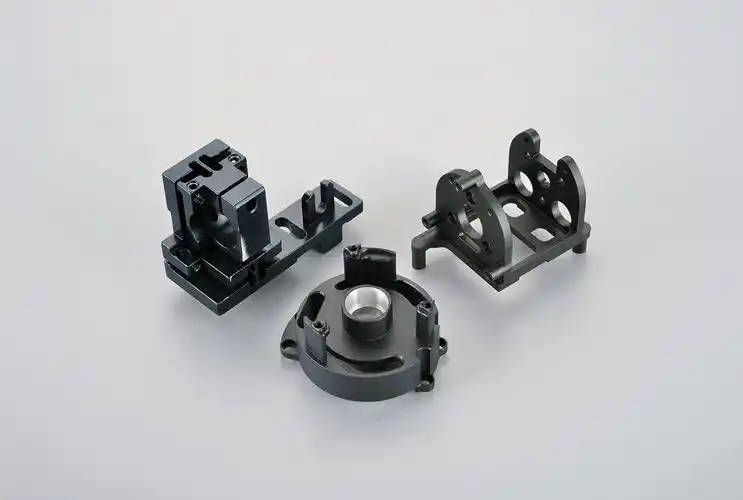
Material / component reference supplied for this page. Grade is verified during stock selection.
CNC machining capabilities for Aluminum 6061 parts
6CNC supports both simple aluminum components and parts where multiple features must relate accurately to one another.
CNC milling
Suitable for:
- Housings
- Brackets
- Manifolds
- Base plates
- Fixtures
- Heat sinks
- Robotic components
- Electronic enclosures
- Machine frames and structural blocks
3-axis machining is efficient for conventional prismatic geometry, while 4-axis and 5-axis machining can reduce setups for parts with features on multiple faces.
CNC turning
6061 is also well suited to turned parts such as:
- Bushings
- Spacers
- Sleeves
- Couplings
- Valve components
- Threaded adapters
- Cylindrical housings
- Pulleys and hubs
Live-tool or mill-turn machining can combine turned features with flats, holes, slots, cross-holes, or milled details in fewer setups.
What tolerances can be achieved in 6061?
The achievable tolerance depends on part size, geometry, feature type, wall thickness, datum strategy, machine access, and inspection method.
Do not assign the tightest tolerance to the entire drawing unless the function requires it. Doing so can increase setup count, inspection burden, machining time, and cost without improving part performance.
For precision parts, it is better to identify:
- Bearing fits
- Sealing diameters
- Alignment bores
- Mating datums
- Hole patterns
- Parallel or perpendicular surfaces
- Flatness-sensitive mounting faces
- Position-critical threaded features
6CNC reviews these relationships during quotation and process planning. CMM, image measurement systems, gauges, micrometers, calipers, and other inspection tools can be selected according to the feature being verified.
Surface finishes for machined 6061 aluminum
6061 responds well to a broad range of post-machining finishes.
As machined
Best when dimensional function, lead time, and cost are more important than a uniform cosmetic appearance. Fine tool marks may remain visible.
Bead blasting
Produces a more uniform matte appearance and helps reduce the visual contrast of machining marks. Dimensional masking may be required on critical fits.
Type II anodizing
A common choice for corrosion resistance, appearance, electrical insulation, and color. Black, clear, and other colors are widely used.
Type III hard anodizing
Used where greater surface hardness and wear resistance are needed. Engineers should account for coating buildup on precision dimensions and threads.
Chemical conversion coating
Useful where corrosion protection and electrical conductivity requirements differ from anodizing.
Painting and powder coating
Suitable for larger structural parts, branded equipment, enclosures, guards, or parts requiring a specific color system.
Surface treatment should be specified before final dimensional planning because coatings can alter finished dimensions.
Common Aluminum 6061 parts we machine
6061 works especially well where a component needs to be lightweight, reasonably strong, corrosion resistant, and straightforward to manufacture.
Typical parts include:
- Robot brackets and structural links
- Automation mounting plates
- Sensor and camera mounts
- Pneumatic and hydraulic manifolds
- Semiconductor equipment components
- Electronic housings
- Instrument enclosures
- Optical support frames
- Medical equipment fixtures
- Machine vision mounts
- Motor mounting plates
- Test fixtures and jigs
- Couplings, hubs, spacers, and adapters
- Heat-management components
- Prototype product chassis
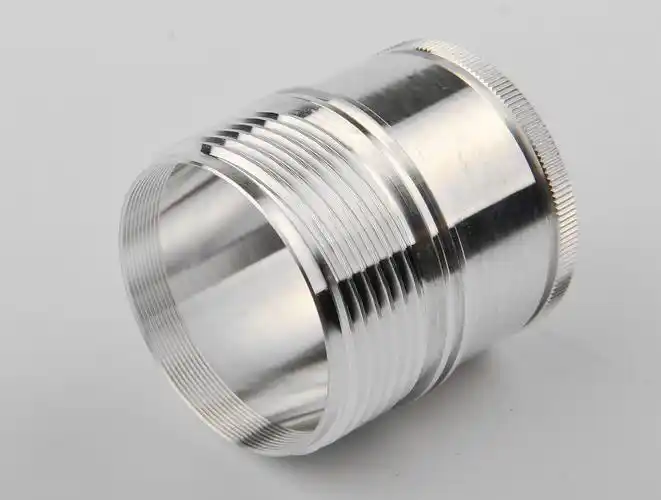
Material / component reference supplied for this page. Grade is verified during stock selection.
When 6061 may not be the right alloy
6061 is versatile, but it is not automatically the best aluminum for every part.
Consider 7075 when substantially higher strength is the priority and welding is not required.
Consider 2024 where high fatigue performance and aerospace heritage are important and corrosion protection can be managed.
Consider 5052 for formed sheet, welded sheet assemblies, or demanding marine/corrosive environments.
Consider 6082 for structural applications where the European EN AW-6082 supply chain or higher-strength 6xxx material is preferred.
Material selection should follow the function of the finished part, not simply the popularity of the alloy.
Design guidance for lower-cost 6061 CNC parts
A few design choices can materially improve machining efficiency.
Keep internal corner radii realistic. Milling cutters are round. Deep pockets with very small internal radii require smaller tools, longer cycle times, and more conservative cutting conditions.
Avoid unnecessary deep narrow pockets. Tool reach and rigidity become more important as depth increases.
Give thin walls enough support. Very thin geometry can vibrate or move during finishing.
Call out only functional tolerances. Use general tolerances for noncritical dimensions and explicit limits only where they affect fit, sealing, alignment, or performance.
Specify cosmetic expectations. If appearance matters after anodizing, define which surfaces are cosmetic and whether rack marks, plug marks, or color variation are acceptable.
Provide 3D CAD plus a controlled drawing. The model defines geometry; the drawing communicates tolerances, threads, finishes, datums, critical dimensions, and special notes.
Why machine Aluminum 6061 with 6CNC?
6CNC focuses on custom precision parts from prototype through small-batch production.
Our machining workflow can include engineering review, process planning, in-process control, and final dimensional verification rather than treating inspection as the first point at which critical features are checked.
6CNC supports:
- CNC milling, turning, and multi-axis machining
- Prototype to small-batch production
- Complex custom aluminum parts
- Multiple surface finishing options
- CMM and dimensional inspection
- Material and drawing traceability where required
- FAI, SPC, PPAP, or COC support when specified
- Engineering communication for manufacturability questions
Our quality team includes 9+ quality engineers and more than 20 types of inspection tools across dimensional and material verification.
Aluminum 6061 CNC Machining FAQs
Is 6061-T6 easy to CNC machine?
Yes. 6061-T6 is generally considered a good machining aluminum because it supports productive cutting conditions and predictable finishing. Part geometry, residual stress, tool reach, workholding, and thin sections can still affect dimensional results.
Is 6061 suitable for precision parts?
Yes. It is widely used for precision housings, fixtures, brackets, manifolds, instrument components, automation parts, and electronic hardware. The machining process and inspection plan should match the drawing requirements.
What is the difference between 6061-T6 and 6061-T651?
Both use the T6 heat-treatment condition. T651 includes mechanical stress relief after heat treatment and is commonly encountered in plate stock. It can be beneficial when dimensional stability is important.
Can 6061 aluminum be anodized?
Yes. 6061 is widely anodized. Type II and Type III anodizing are common choices depending on appearance, corrosion, electrical, and wear requirements.
Is 6061 better than 7075 for CNC machining?
Neither is universally better. 6061 is usually more economical, more corrosion resistant, easier to weld, and highly practical for general machining. 7075 provides much higher strength for demanding structural applications.
What files should I send for a quote?
For best results, send a 3D CAD model plus a PDF drawing showing critical tolerances, threads, material temper, surface finish, inspection requirements, and quantity.
From Drawing to Finished Part
01
Share your files
Send the CAD model, controlled drawing, quantity and required material condition.
02
Review the process
6CNC reviews stock, machining access, critical dimensions, finishing and inspection.
03
Machine and finish
Production follows the agreed drawing, material and surface requirements.
04
Inspect and deliver
Dimensional verification and requested documentation accompany the agreed delivery.
Compare Aluminum Alloys
Choose around loading, corrosion, forming, finishing and the specified stock condition.
Start your project with 6CNC
Let’s review your Aluminum 6061 part.
Send your design files for a project-specific material, machining and quotation review.
Include with your enquiry
- 3D CAD and controlled PDF drawing
- Alloy, temper and stock specification
- Quantity and delivery target
- Critical dimensions, datums and threads
- Surface finish and inspection requirements
Related Material Grade Guides
Compare 6061 with magnesium for low density and Grade 5 titanium for higher strength.