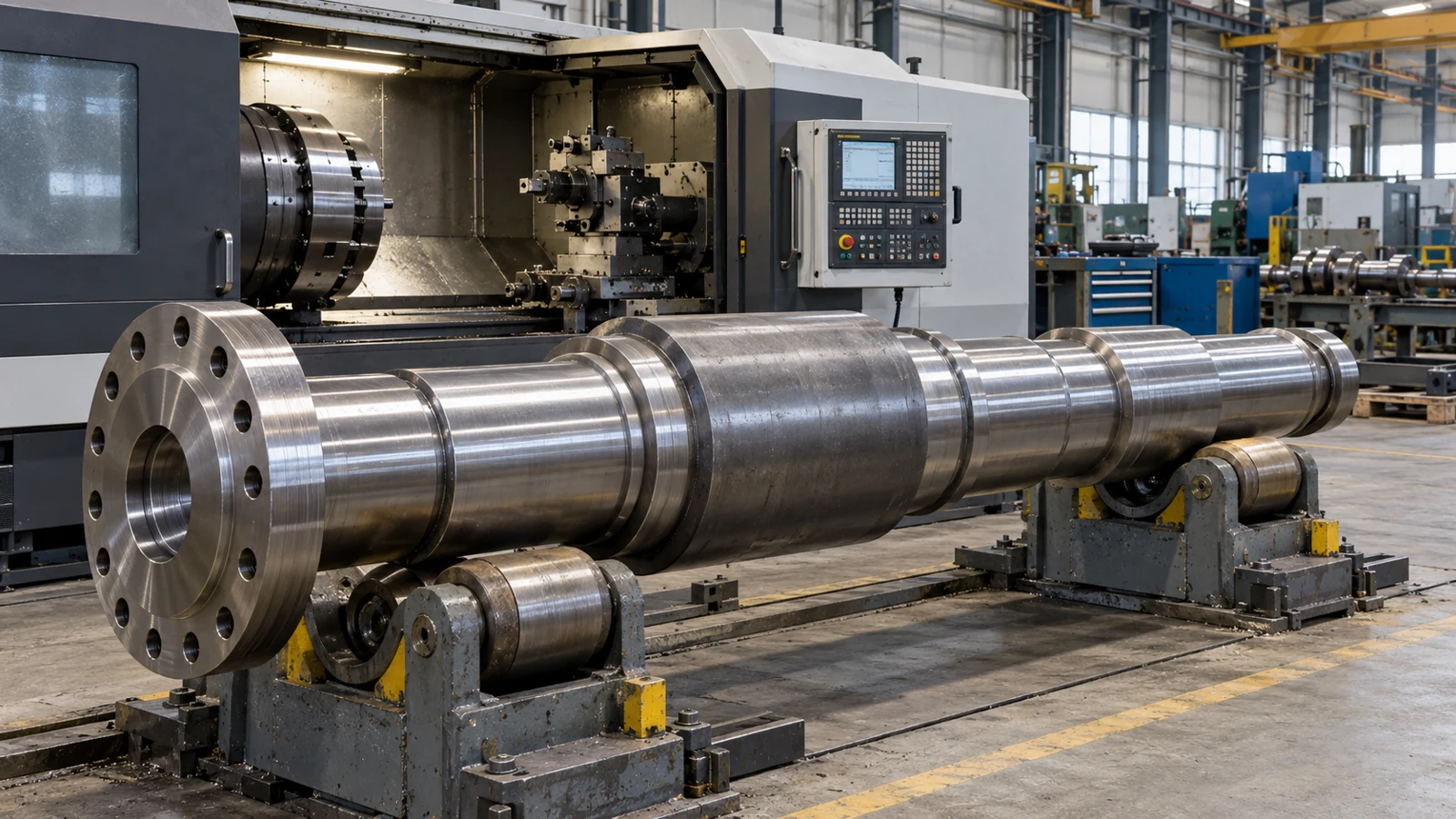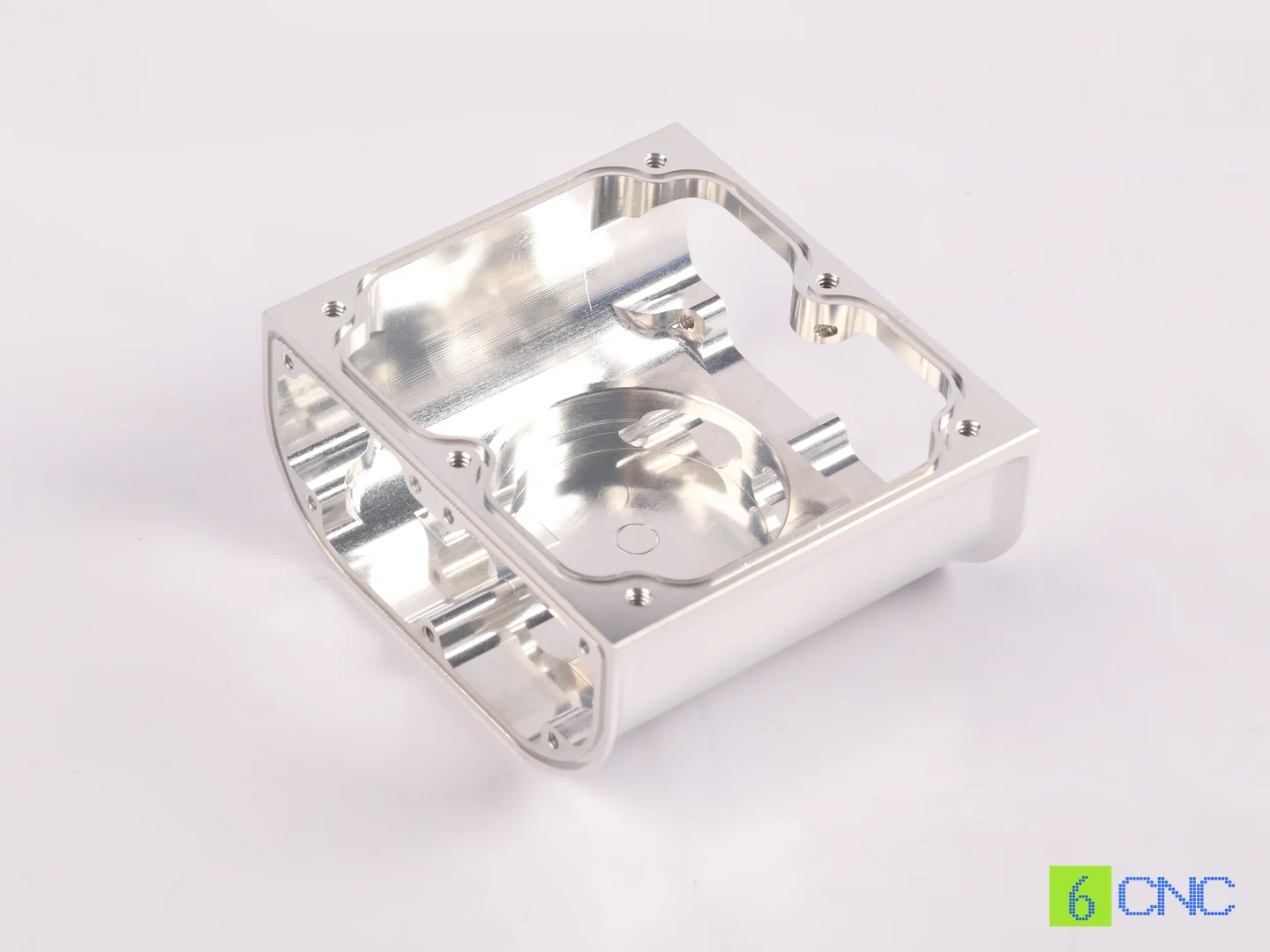
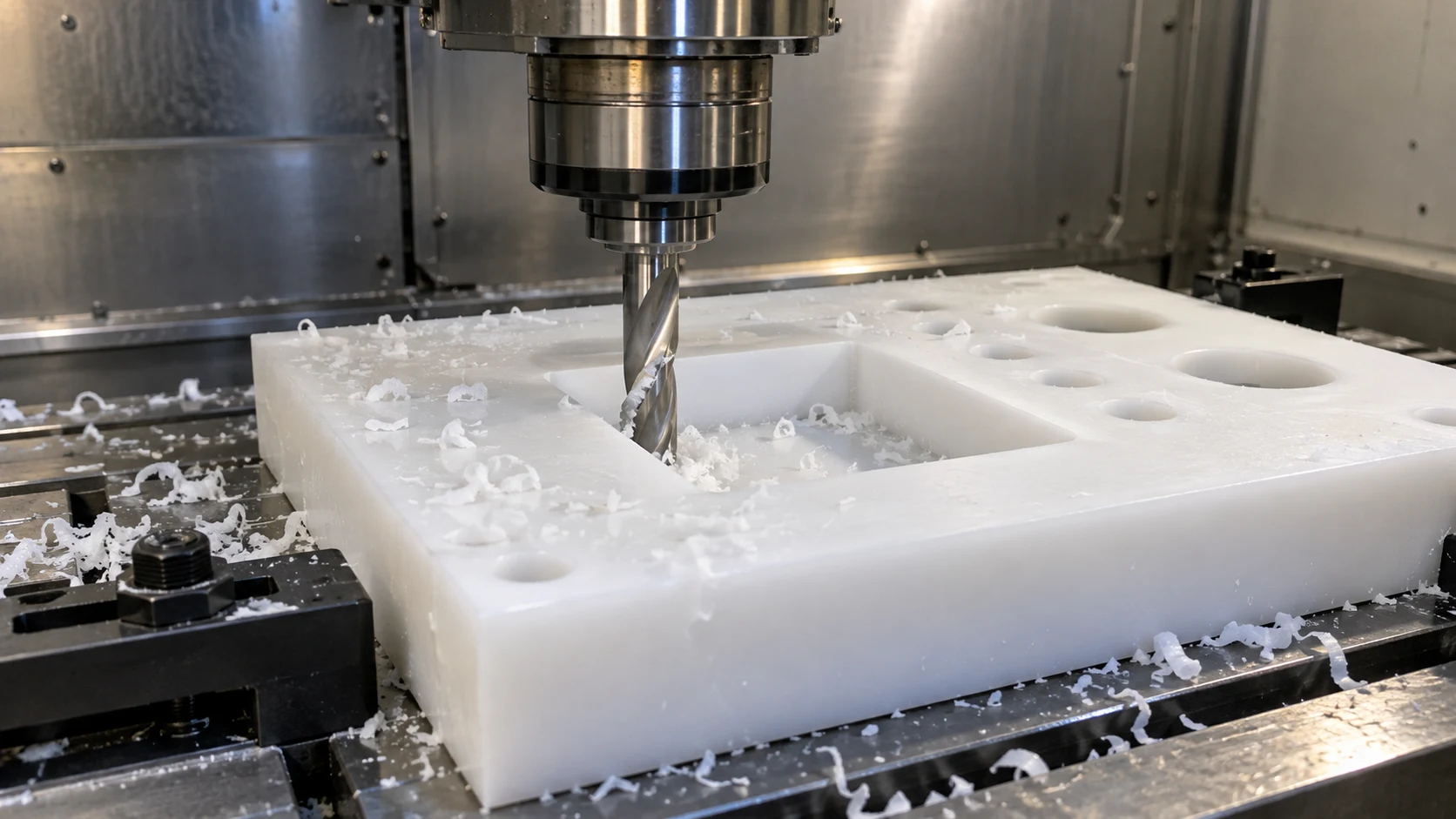
HDPE is one of the easier plastics to cut, but that does not mean it behaves like aluminum on a CNC machine.
High-density polyethylene generates relatively low cutting forces, does not normally create severe tool wear, and can be milled, turned, drilled, routed, and threaded using conventional CNC equipment. Those characteristics make it attractive for chemical equipment, guides, wear parts, marine components, fixtures, food-processing equipment, and many other industrial applications.
The real challenge is dimensional control.
HDPE is significantly softer and less rigid than metals. It expands more with temperature, can deform under clamping pressure, and may move after material is removed. A part can therefore look excellent directly from the machine and still measure differently after it has cooled or been released from the fixture.
For this reason, successful HDPE machining is less about aggressive material removal and more about controlling heat, workholding, tool sharpness, chip evacuation, and realistic tolerances.
This guide explains how CNC machining HDPE works, which tools and machining strategies are effective, what tolerances are realistic, how to avoid deformation and poor surface finish, and how HDPE compares with materials such as UHMW, POM/Delrin, PTFE, and other engineering plastics.
What Is HDPE?
HDPE stands for high-density polyethylene, a thermoplastic produced from polyethylene with a relatively high degree of molecular crystallinity.
Compared with low-density polyethylene, HDPE generally offers greater stiffness and strength while retaining good toughness and chemical resistance.
Typical properties that make it useful for machined components include:
- low density;
- good impact resistance;
- excellent moisture resistance;
- broad chemical resistance;
- relatively low friction;
- good machinability;
- relatively low material cost.
HDPE is widely available in:
- sheet;
- plate;
- rod;
- tube;
- extruded profiles.
It is also available in several formulations, including natural, black UV-stabilized, high-molecular-weight, and specialty grades.
Not all polyethylene materials behave exactly the same way. Standard HDPE and UHMW-PE, for example, belong to the same general material family but differ substantially in wear behavior, stiffness, molecular weight, and machining characteristics.
For grade selection and manufacturing options, explore our engineering plastics CNC machining service.
Why CNC Machine HDPE Instead of Molding It?
HDPE is widely associated with injection molding, blow molding, and extrusion. Bottles, tanks, pipes, containers, and countless consumer products are produced using these high-volume processes.
CNC machining serves a different production need.
It is particularly useful when the project requires:
- prototypes;
- low-volume components;
- thick plate geometry;
- tighter local dimensions;
- custom fixtures;
- frequent design changes;
- large parts;
- no dedicated mold investment.
Imagine an industrial chemical-handling system requiring 20 custom HDPE valve-support blocks.
Injection molding tooling would make little economic sense for such a small quantity.
The blocks can instead be cut from HDPE plate and CNC machined directly to the required geometry.
If the design changes later, the CAD model and CNC program can simply be updated.
That flexibility is one of the main reasons CNC machining remains important even for materials that are extremely common in molding.
Common HDPE Grades for CNC Machining
Not every material sold as HDPE is identical.
Grade selection should reflect the operating environment.
Standard HDPE
General-purpose HDPE works well for:
- industrial components;
- fixtures;
- spacers;
- guides;
- tanks;
- wet-environment parts.
It offers a useful balance between cost, toughness, chemical resistance, and machinability.
UV-Stabilized HDPE
Outdoor applications may use black or otherwise UV-stabilized formulations.
Typical uses include:
- marine equipment;
- outdoor machinery;
- agricultural components;
- construction hardware.
Standard natural HDPE can degrade under long-term UV exposure, so outdoor service conditions should be considered when specifying the material.
High-Molecular-Weight HDPE
Higher-molecular-weight grades can provide greater impact and wear resistance.
They may be selected for industrial wear parts where ordinary HDPE would not provide sufficient service life.
Food-Contact or Regulatory Grades
Some HDPE products are produced to specific food-contact or other regulatory requirements.
The material certificate and exact resin grade matter when regulatory compliance is required.
A generic statement that “HDPE is food safe” is not enough. The actual supplied material needs to meet the relevant requirement for the application.
HDPE Is Easy to Cut but Harder to Hold Precisely
This is the most important concept to understand.
HDPE does not resist a cutting tool the way stainless steel or titanium does.
Machining forces are relatively low, which sounds ideal.
But that same softness means the material also moves more easily.
Several forms of movement can occur.
Clamping deformation
A vise can compress the workpiece.
The machinist may then cut the part while it is held in a slightly distorted state.
After the jaws release, the material springs back and dimensions change.
Cutting-force deflection
Thin walls can move away from the cutter.
Thermal expansion
Heat from machining can temporarily increase dimensions.
Residual stress
Extruded or molded stock may contain internal stress that is released as material is removed.
These effects explain why quoting an extremely tight tolerance for all HDPE parts is usually unrealistic.
The achievable tolerance depends on size, geometry, stock condition, temperature, workholding, and where the tolerance is located.
Part size, geometry, stock thickness, machining sequence, and inspection temperature all affect final dimensions; no single tolerance should be applied as a blanket capability.
Realistic Tolerances for CNC-Machined HDPE
It is possible to machine HDPE quite accurately, but tolerance should be specified with the material’s physical behavior in mind.
A compact, thick component with short feature relationships can hold much tighter dimensions than a long, thin plate.
For example:
A 20 mm diameter bore inside a thick HDPE block is easier to control than the overall width of a 600 mm long thin panel.
A tolerance of ±0.05–0.10 mm may be a starting point for discussing selected compact features, subject to a manufacturing review and trial inspection. It is not a universal HDPE tolerance or a guaranteed 6CNC capability.
For many general-purpose parts, wider tolerances are more appropriate and more economical.
The engineer should ask:
- Does this dimension control assembly?
- Is it a sliding or press fit?
- How large is the component?
- Will the operating temperature vary?
- Is the measurement taken at controlled temperature?
A ±0.02 mm requirement that is routine on a small metal feature may provide little practical value on a large HDPE part if normal temperature variation alone can move the dimension by more than that amount.
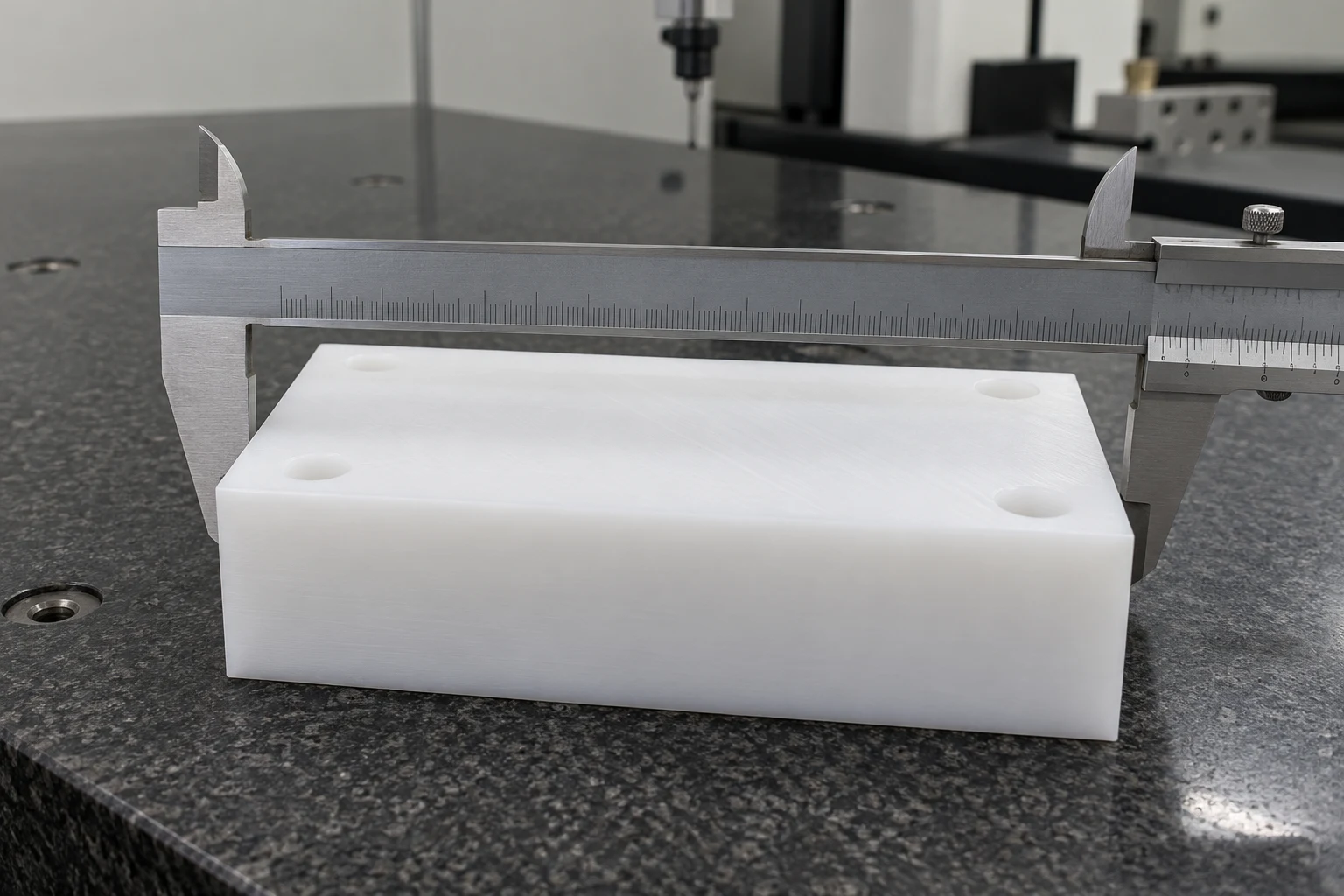
For drawing callouts, see how to specify CNC tolerances correctly.
Thermal Expansion Is a Major HDPE Design Issue
HDPE expands significantly more with temperature than metals.
This affects both machining and final use.
Suppose a long HDPE rail is machined in a warm workshop and later installed in a cooler environment.
Its overall length can change enough to matter if the assembly has no allowance for movement.
This is particularly important for:
- long guide rails;
- large plates;
- panels;
- machine guards;
- marine components;
- outdoor equipment.
Thermal expansion also affects inspection.
A precision dimension measured while the part is warm from machining may not match the same dimension later after thermal stabilization.
For tighter-tolerance components, allow the part to reach a stable temperature before final inspection.
The inspection temperature should also be understood when critical dimensions are specified.
Choosing Cutting Tools for HDPE
HDPE does not normally require exotic tooling.
The most important requirement is a sharp cutting edge.
A sharp tool shears the polymer cleanly.
A dull tool creates more friction and heat, which can cause smearing, melted edges, poor finish, and dimensional movement.
Carbide End Mills
Sharp carbide end mills work well for most HDPE milling.
Tools designed for aluminum or plastics are often effective because they provide:
- sharp cutting edges;
- large flute space;
- efficient chip evacuation.
One- or two-flute cutters can be useful because HDPE generates relatively large chips and benefits from open flute space.
Polished-Flute Tools
Polished flutes help reduce friction and prevent plastic chips from sticking to the cutter.
These are especially useful when surface finish and chip evacuation matter.
O-Flute Cutters
O-flute cutters are common in plastic routing.
Their geometry helps produce clean cutting action and efficient chip removal in thermoplastics.
They are particularly useful for:
- sheet;
- panels;
- routed profiles;
- larger flat HDPE components.
Why Extremely Hard or Coated Tools Are Usually Not the Main Issue
Some guides recommend expensive coated or diamond tooling for HDPE.
For ordinary unfilled HDPE, extreme wear resistance is rarely the primary machining challenge.
HDPE is not particularly abrasive.
Tool sharpness is usually more important than exotic coating.
Diamond or specialized tooling may make sense for long production runs or reinforced plastics, but for normal HDPE, a sharp high-quality carbide cutter is usually more practical.
The machining strategy should focus first on:
- edge sharpness;
- chip clearance;
- low friction;
- controlled heat.
CNC Milling HDPE
CNC milling is the most flexible process for custom HDPE parts.
It can produce:
- pockets;
- mounting holes;
- slots;
- profiles;
- recesses;
- sealing features;
- custom 3D geometry.
Because HDPE cuts easily, material removal can often be relatively fast.
However, aggressive machining is not always the best choice.
Heavy tool engagement generates more heat and may push flexible features.
A common strategy is to separate roughing and finishing.
During roughing, most material is removed efficiently while leaving controlled finishing stock.
A final light pass then establishes the critical geometry after the major internal stress and material removal have already occurred.
This is particularly useful for flatness, wall thickness, and precision pockets.
Review wall thickness, pocket depth, and tool access in our CNC milling design guide.
CNC Turning HDPE
Turning works well for cylindrical HDPE components such as:
- bushings;
- spacers;
- sleeves;
- rollers;
- rings;
- fluid-system components.
Again, sharp tooling matters.
The cutting edge should remove a clean chip rather than push and smear the polymer.
Long flexible parts may require additional support because the material itself can deflect.
Thin rings can also distort after machining if excessive jaw pressure is used.
Soft jaws or larger gripping surfaces can distribute clamping force more evenly.
CNC Routing HDPE Sheet
Large HDPE sheets are commonly machined using CNC routers.
Applications include:
- machine guards;
- marine panels;
- liners;
- fabrication components;
- large fixtures;
- industrial panels.
Routing is often more efficient than machining a large sheet on a conventional machining center.
Vacuum workholding may be used for broad flat parts, although the method needs enough surface area to generate secure holding force.
For smaller components nested from sheet, tabs or onion-skin strategies may be used to prevent the parts from moving when the final contour is completed.
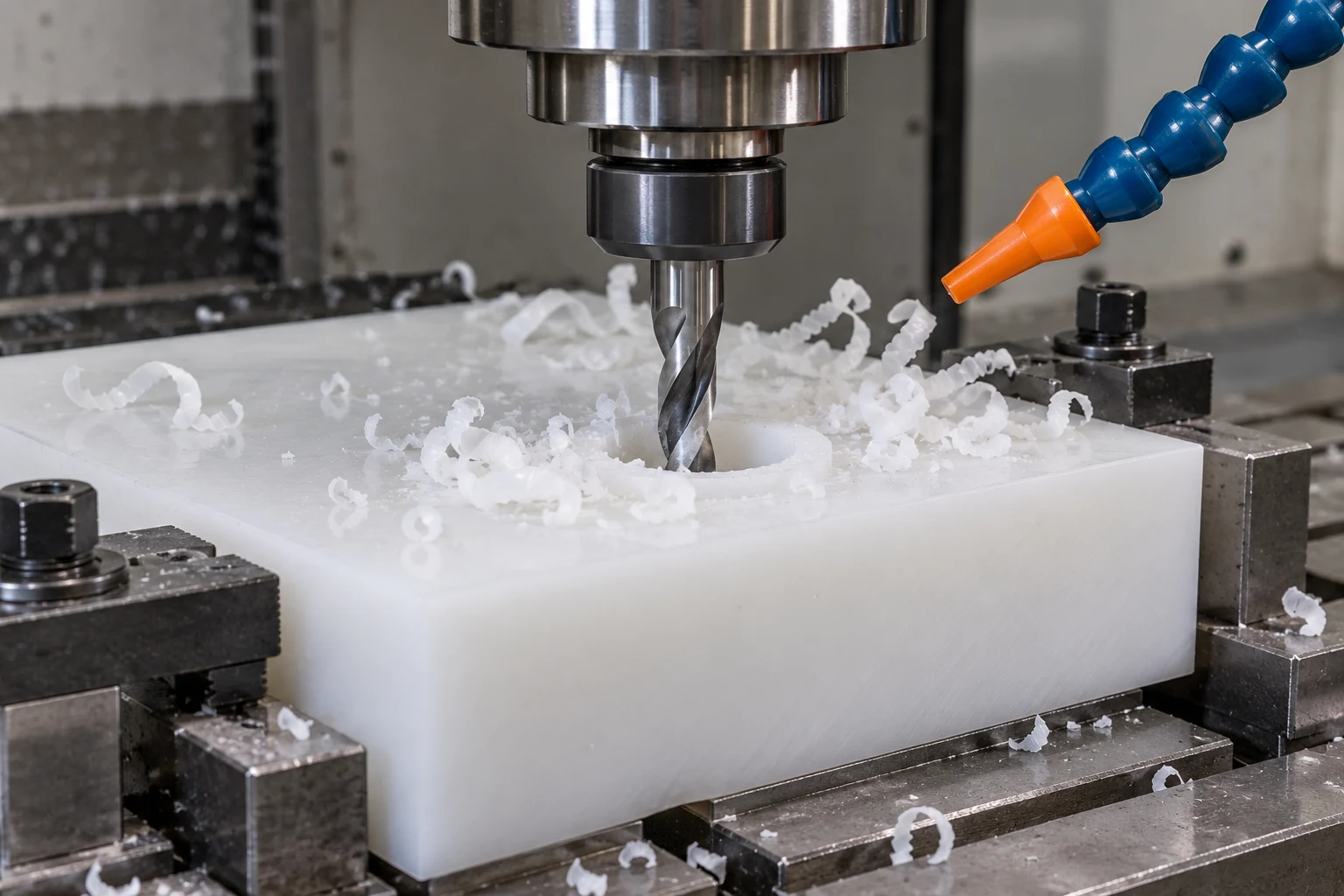
Drilling HDPE
Drilling HDPE appears easy but can create several problems.
Long stringy chips may wrap around the drill.
Heat can also build inside a deep hole.
Good drilling practice may involve:
- sharp drills;
- appropriate point geometry;
- peck cycles where necessary;
- clearing chips frequently;
- avoiding excessive dwell.
Drill exit burrs can occur when the remaining material becomes too thin to support the cutting action.
A backing plate or controlled finishing strategy can improve exit quality.
Machining Holes Accurately in HDPE
Hole diameter deserves special attention.
A drill does not always produce the most accurate final bore.
For important fits, possible strategies include:
- drilling undersize then boring;
- interpolation with an end mill;
- boring;
- reaming where appropriate.
However, the fit must still account for HDPE’s temperature sensitivity and flexibility.
A very tight interference fit can behave differently depending on temperature and assembly force.
For precision assemblies, it is better to define the required functional fit rather than blindly applying metal-fit practices.
Compare hole-finishing methods in our CNC boring process guide.
Threading HDPE
HDPE can be threaded using:
- taps;
- thread mills;
- single-point turning;
- molded or inserted metal threads.
Threads cut directly into HDPE are suitable for many low-load applications.
However, the material is much softer than metal.
Repeated assembly can wear the threads, especially when using metal screws.
For components that will be disassembled frequently or heavily loaded, consider:
- threaded inserts;
- captive nuts;
- metal inserts.
Thread design should also provide sufficient engagement length.
A short fine-pitch thread that works well in aluminum may not provide enough strength in HDPE.
Thread Milling vs Tapping HDPE
Tapping is fast and simple for standard threads.
Thread milling offers more control and may be useful when:
- the thread diameter is larger;
- one tool needs to produce several thread sizes;
- thread diameter adjustment is important.
For ordinary HDPE parts, however, tapping is often perfectly adequate.
The decision should be based on part geometry and production needs rather than assuming the more advanced process is always better.
Chip Control: One of the Biggest Practical Challenges
HDPE often forms long, continuous, stringy chips.
These chips can:
- wrap around the cutter;
- accumulate around the spindle;
- remain inside pockets;
- scratch the finished surface;
- reduce cooling.
The solution is usually better chip evacuation rather than slower machining.
Useful methods include:
- compressed air;
- vacuum extraction;
- high-clearance flutes;
- toolpaths that allow chips to escape;
- regular chip clearing.
Deep pockets deserve particular attention because chips can remain trapped and be recut repeatedly.
Plan chip evacuation before machining deep pockets or enclosed features.
Heat Management During HDPE Machining
HDPE has a relatively low softening temperature compared with metals.
Excessive friction can therefore lead to:
- melted edges;
- smeared surfaces;
- chips welding to the part;
- dimensional movement.
Heat normally increases because of:
- dull tools;
- excessive rubbing;
- poor chip evacuation;
- unsuitable feeds;
- excessive spindle speed without enough chip load.
One of the most common mistakes is treating plastics like metals and running the tool at high RPM with very light feed.
This can create rubbing instead of clean chip formation.
A sharp tool should remove a meaningful chip so that heat leaves with the chip rather than remaining in the workpiece.
Air Cooling vs Liquid Coolant
Compressed air is often effective for HDPE because it:
- removes chips;
- provides some cooling;
- avoids introducing liquid contamination.
Liquid coolant can also be used in suitable applications, but compatibility with the material and downstream process should be considered.
For food-contact, medical, or clean applications, coolant residues may create extra cleaning requirements.
The correct choice depends on the part and manufacturing environment.
Feeds and Speeds for HDPE
There is no single correct RPM or feed rate for HDPE.
The correct parameters depend on:
- tool diameter;
- flute count;
- cutter geometry;
- depth of cut;
- toolpath;
- machine rigidity;
- part geometry.
A small router cutter and a large milling cutter should not use the same parameter set.
This is why fixed recommendations such as “400–1000 RPM” are often not very useful without specifying tool diameter and chip load.
Reference values should be treated as starting points only.
The machinist should watch for:
- chips rather than dust;
- melted surfaces;
- chip wrapping;
- vibration;
- dimensional movement.
For plastic machining, maintaining a clean cutting action is generally more important than targeting one universal spindle-speed number.
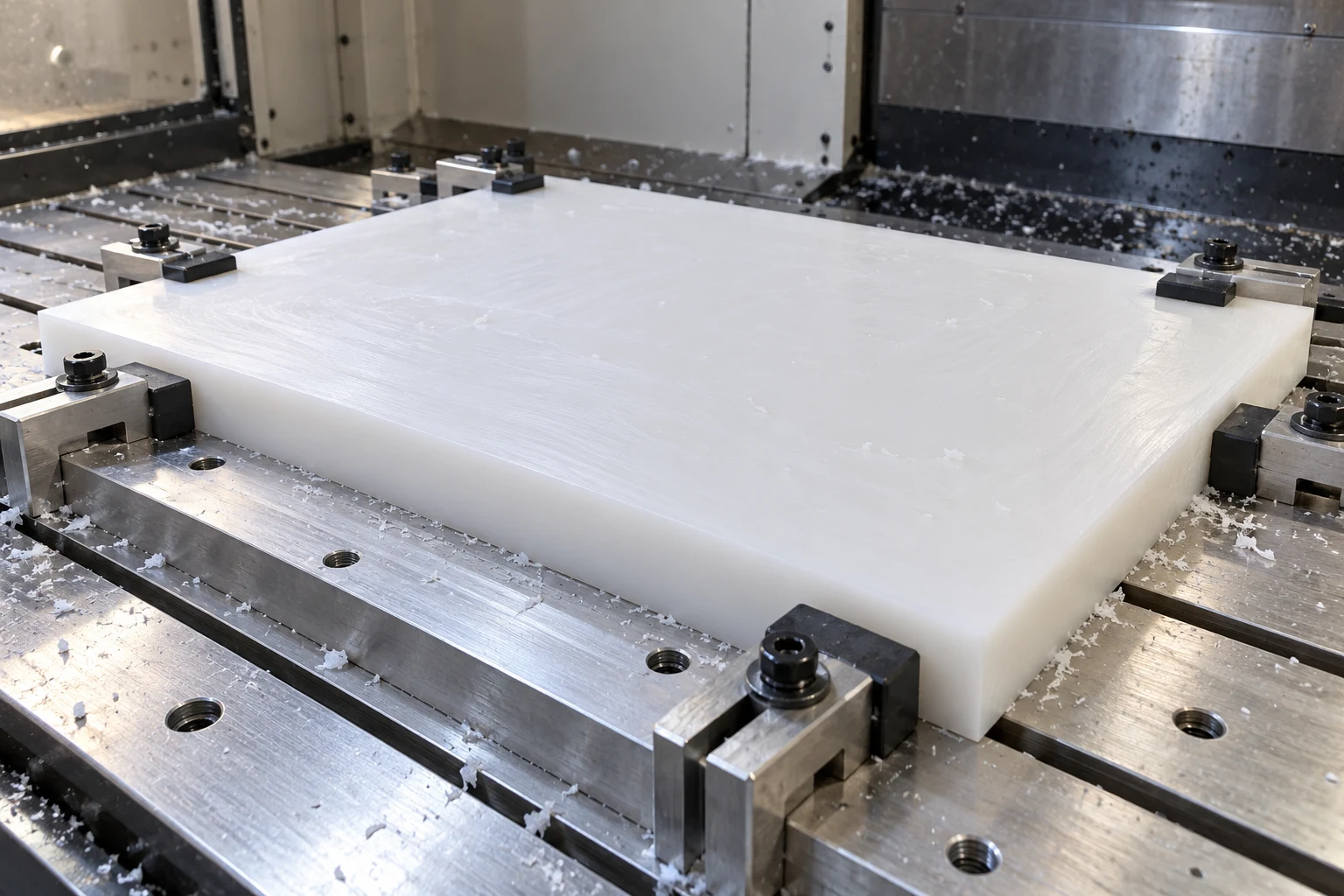
Clamping HDPE Without Distorting It
Workholding is one of the areas where experienced plastic machining differs most from metal machining.
HDPE can be compressed noticeably under vise pressure.
If a thin plate is clamped aggressively along two sides, it may bow.
The machine then cuts the distorted shape.
After the clamps are released, the part changes shape.
This can lead to:
- poor flatness;
- incorrect width;
- wall-thickness variation.
Better workholding methods may include:
- soft jaws;
- wider clamping surfaces;
- lower clamping pressure;
- vacuum fixtures;
- sacrificial plates;
- distributed screws;
- double-sided fixture tape for light operations;
- custom nests.
The objective is enough holding force to resist machining without unnecessarily deforming the material.
Thin-Wall HDPE Machining
Thin-wall HDPE parts can be particularly difficult to hold accurately.
Because the material has low stiffness, even moderate cutting pressure may move the wall.
For example, consider a thin HDPE chemical tray with a deep internal cavity.
During roughing, the remaining wall is still supported by surrounding stock.
As the cavity becomes deeper, the wall becomes increasingly flexible.
A heavy finishing pass can push the wall away from the cutter.
Possible strategies include:
- leaving thicker walls during roughing;
- finishing both sides gradually;
- reducing final cutting force;
- adding temporary support;
- using sharp tools;
- avoiding excessive tool overhang.
The same principles used for thin aluminum parts apply, but HDPE is even more compliant.
For support and process-planning considerations, explore thin-wall CNC machining.
Flatness Can Be Difficult on Large HDPE Parts
Large HDPE plates often contain internal stress from manufacturing.
Removing material from only one side can unbalance that stress.
The plate may bow.
For parts requiring good flatness, the machining strategy may involve:
- rough machining one side;
- flipping the plate;
- removing material from the opposite side;
- allowing the part to stabilize;
- finish machining both sides.
Symmetrical material removal can reduce distortion.
The starting stock condition also matters.
A precision-machined plate should ideally begin with material selected for stable machining behavior rather than relying only on final toolpath compensation.
Should HDPE Be Annealed Before Machining?
Annealing is sometimes recommended for engineering plastics to reduce internal stress.
Whether it is useful depends on the material form, supplier, amount of material removal, and dimensional requirements.
It should not automatically be added to every HDPE project.
For many general-purpose parts, appropriate stock selection and balanced machining are sufficient.
For large components requiring extensive material removal and tighter flatness, stress-relief or supplier-recommended thermal conditioning may be worth evaluating.
Always follow the material manufacturer’s recommended thermal cycle rather than using a generic annealing temperature copied from another polymer.
Surface Finish on Machined HDPE
A sharp tool can produce a smooth HDPE surface directly from machining.
Typical surface problems include:
- fuzzing;
- smearing;
- tool marks;
- melted edges;
- burrs.
These problems often indicate:
- dull tooling;
- rubbing;
- poor chip evacuation;
- excessive heat.
Unlike metal parts, polishing HDPE is not always the easiest way to improve the finished condition.
In many cases, improving the machining process itself creates a better surface.
Cosmetic requirements should also be realistic.
Plastic surfaces can scratch more easily during handling than anodized aluminum or hardened steel.
Burrs and Edge Finishing
HDPE can leave soft burrs or raised edges around:
- drilled holes;
- slots;
- milled profiles.
Deburring may be performed with:
- sharp hand tools;
- chamfer cutters;
- controlled scraping;
- trimming.
Heat-based deburring should be used carefully because the material can deform.
A small CNC-machined chamfer often provides a cleaner and more repeatable result than aggressive manual edge finishing.
HDPE vs UHMW: What Is the Difference for Machining?
HDPE and UHMW-PE are related materials, but they should not be treated as identical.
UHMW has an extremely high molecular weight and is widely used for:
- wear strips;
- chain guides;
- bearings;
- low-friction surfaces;
- impact-resistant parts.
Compared with standard HDPE, UHMW typically provides superior abrasion resistance and lower friction.
However, it can also be softer and more difficult to hold dimensionally in some geometries.
If the application needs chemical resistance and general structural plastic performance, HDPE may be sufficient.
If sliding wear is the primary requirement, UHMW may be the better material.
HDPE vs Delrin/POM
POM, often known by the trade name Delrin for some grades, is significantly stiffer and more dimensionally stable than HDPE.
It is often preferred for:
- precision bushings;
- gears;
- mechanical mechanisms;
- dimensional parts.
HDPE generally offers:
- lower cost;
- better impact behavior;
- strong chemical resistance.
POM generally offers:
- better stiffness;
- better dimensional stability;
- tighter machinability for precision mechanical features.
If the drawing contains several tight dimensions and rigid mechanical fits, POM may be a better candidate than HDPE.
For a stiffer alternative for precision mechanical features, see POM / Delrin CNC machining.
HDPE vs PTFE
PTFE provides excellent chemical resistance and extremely low friction.
However, it is much softer and more prone to creep than HDPE.
PTFE is useful for:
- seals;
- low-friction components;
- chemical-service parts.
HDPE generally offers better structural stiffness for larger general-purpose components.
Material selection should therefore consider long-term load rather than chemical resistance alone.
HDPE vs PEEK
PEEK is a much higher-performance engineering polymer.
Compared with HDPE, it provides:
- much higher temperature resistance;
- greater mechanical strength;
- better stiffness;
- stronger dimensional stability.
But PEEK is dramatically more expensive.
Using PEEK for an ordinary chemical-resistant guide block would usually be unnecessary if HDPE satisfies the actual operating conditions.
HDPE is attractive precisely because it provides useful properties at relatively low cost.
For demanding temperature and material-grade requirements, read our PEEK CNC machining guide.
HDPE vs Nylon
Nylon generally offers higher strength and stiffness than HDPE but absorbs considerably more moisture.
This can affect dimensions.
HDPE has very low water absorption and may therefore be preferable in continuously wet environments.
For gears or mechanical components requiring greater rigidity, nylon may still be more appropriate.
Explore the properties and application considerations of Nylon 6/6 CNC machining.
Material Comparison
| Property | HDPE | UHMW-PE | POM | PTFE | PEEK |
|---|---|---|---|---|---|
| Cost | Low | Low–moderate | Moderate | Moderate–high | Very high |
| Stiffness | Low–moderate | Low | High | Low | Very high |
| Dimensional stability | Moderate/limited | Limited | Good | Limited | Excellent |
| Wear resistance | Good | Excellent | Good | Good | Excellent |
| Chemical resistance | Excellent | Excellent | Good | Excellent | Excellent |
| Moisture absorption | Very low | Very low | Low | Very low | Low |
| High-temperature capability | Limited | Limited | Moderate | High | Excellent |
| Precision machining suitability | Moderate | Moderate | Excellent | Challenging | Excellent |
This table is directional rather than a substitute for checking the exact material grade and service conditions.
Common Applications for CNC-Machined HDPE
HDPE is most valuable where its combination of toughness, chemical resistance, low moisture absorption, and cost matters.
Chemical Processing Equipment
Typical parts include:
- valve blocks;
- chemical tank components;
- guides;
- spacers;
- pump-related supports.
HDPE performs well around many chemicals, but exact compatibility should always be checked against the chemical concentration and operating temperature.
Marine Components
HDPE is widely used in wet environments because it does not absorb much water and resists many forms of corrosion.
Applications include:
- guides;
- pads;
- supports;
- dock hardware;
- boat-related components.
UV-stabilized grades should be considered for outdoor exposure.
Food-Processing Equipment
Suitable certified HDPE grades may be used for:
- cutting surfaces;
- guides;
- fixtures;
- conveyor components.
Material compliance and cleaning requirements should be confirmed for the actual application.
Machine Guards and Industrial Fixtures
HDPE is inexpensive and easy to machine, making it useful for:
- positioning blocks;
- guides;
- protective panels;
- machine fixtures.
Wear Components
HDPE can be used for moderate-wear applications, although UHMW may be preferred where abrasion resistance is the main requirement.
When HDPE Is Not the Best Material
HDPE should not be selected solely because it is inexpensive and easy to machine.
Another material may be better when the part requires:
Very tight dimensional stability
POM or PEEK may be more appropriate.
High operating temperature
HDPE has limited temperature capability compared with higher-performance engineering plastics.
High stiffness
Large structural components may flex too much.
Long-term high mechanical load
Polymer creep should be considered.
High wear resistance
UHMW or another wear material may provide better performance.
The best material is the one that matches the operating conditions, not simply the easiest polymer to purchase.
CNC Machining vs Injection Molding HDPE
Injection molding becomes attractive for large quantities of relatively small repeatable parts.
Advantages include:
- low unit cost at high volume;
- repeatable geometry;
- efficient production.
Disadvantages include:
- mold investment;
- tooling lead time;
- design-change cost.
CNC machining is generally stronger for:
- prototypes;
- low-volume production;
- large thick components;
- changing designs;
- no-tooling projects.
A project may begin with CNC-machined HDPE components and later transition to molding if annual quantity justifies the tooling.
CNC Machining vs Fabricating/Welding HDPE
Large tanks and structures are often fabricated from HDPE sheet using plastic welding rather than machined from solid stock.
This can reduce material waste.
CNC machining may still be used to produce:
- flanges;
- precision interfaces;
- custom blocks;
- mounting components.
For large structures, a combination of fabrication and machining can be more economical than machining everything from billet.
CNC Machining vs 3D Printing HDPE
HDPE itself is relatively difficult to 3D print consistently on many standard FDM systems because warping and bed adhesion can be challenging.
CNC machining from plate or rod provides predictable bulk material properties and good surface quality.
For low-volume precision HDPE parts, machining is therefore often more practical than additive manufacturing.
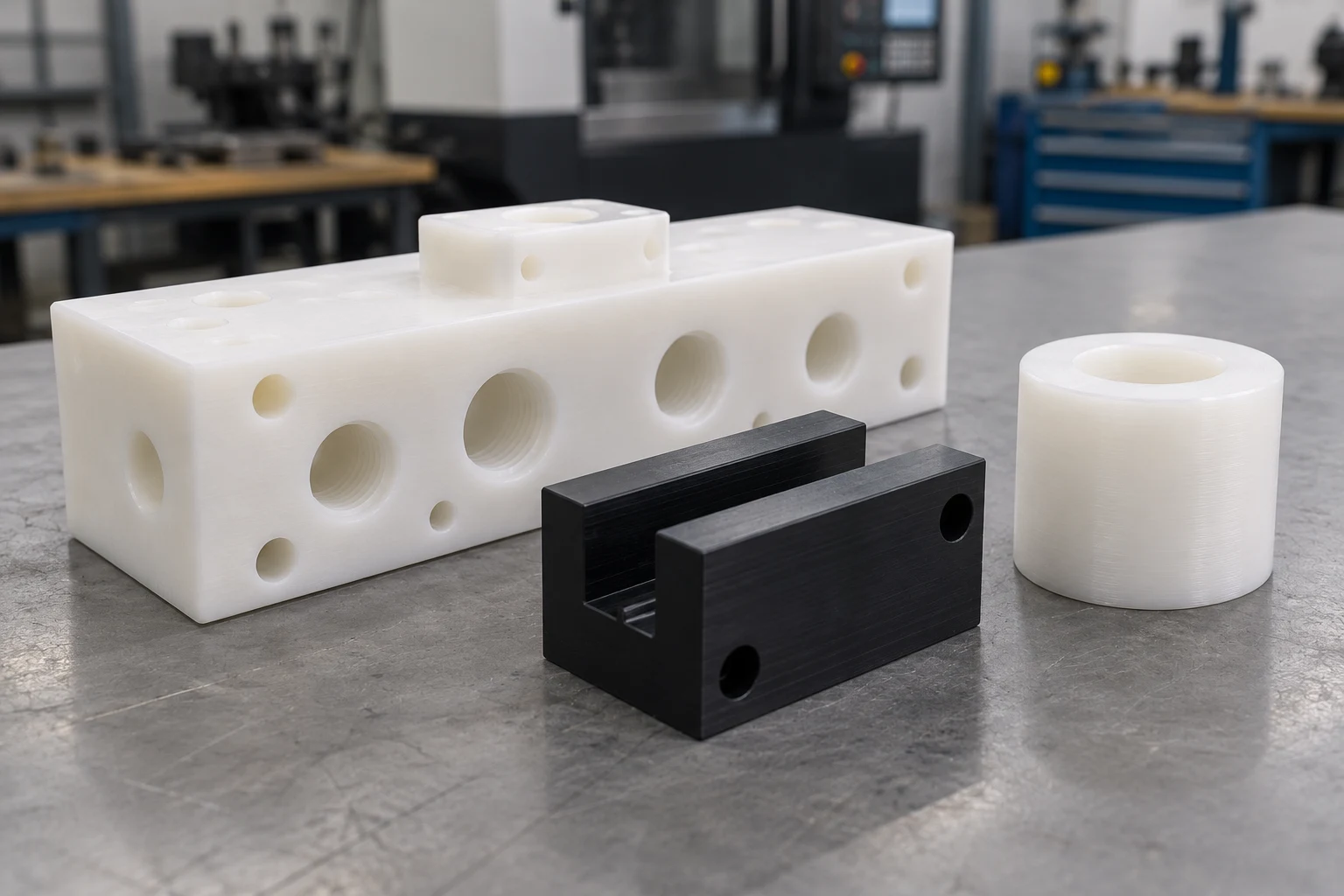
Example: HDPE Chemical Manifold Block
Consider a custom HDPE block used in chemical-handling equipment.
The part contains:
- several drilled ports;
- threaded connections;
- mounting holes;
- a machined sealing face.
The block begins as thick HDPE plate.
The outside surfaces are rough machined first while leaving finishing allowance.
Ports are drilled and threaded using sharp tooling with regular chip clearing.
The sealing face is finish machined using a light pass after most other material has already been removed.
This sequence reduces the amount of stress released after the final sealing surface is established.
The finished component is allowed to stabilize before final inspection.
This is a much better strategy than machining the precision surface first and then removing large amounts of material afterward.
Example: Large HDPE Guide Rail
A 700 mm long guide rail presents a different problem.
The geometry may look simpler than the manifold, but the overall dimension and straightness are more sensitive to thermal expansion and stock movement.
A possible strategy includes:
- rough cutting the blank;
- allowing material to stabilize;
- machining both sides gradually;
- using distributed workholding;
- performing final dimensional inspection at controlled temperature.
The tolerance should also reflect actual machine operating conditions.
Specifying an extremely tight overall-length tolerance on a large HDPE part may not be meaningful if the installed equipment operates across a broad temperature range.
Example: HDPE Fixture Plate
A fixture plate may require:
- locating holes;
- pockets;
- mounting holes;
- clearance features.
HDPE is attractive because the fixture is lightweight, inexpensive, and will not damage sensitive components.
However, if locating holes must position parts with high repeatability, the designer may use:
- metal bushings;
- threaded inserts;
- dowel inserts.
This hybrid approach lets HDPE provide the bulk structure while metal components handle wear-sensitive precision interfaces.
DFM Tips for CNC-Machined HDPE
A few design decisions can dramatically improve machining results.
Avoid excessively thin walls
Thin flexible features are difficult to hold accurately.
Use generous internal corner radii
Larger tools are more rigid and evacuate chips more easily.
Avoid unnecessarily tight tolerances
Apply tight dimensions only to features that control function.
Consider thermal movement
Long parts need more allowance than compact components.
Use inserts for frequently assembled threads
This improves thread life.
Support large flat parts
Avoid designs that depend on very tight unsupported flatness across large areas.
Provide clearance for chip evacuation
Very deep narrow cavities are less attractive in soft plastics.
HDPE CNC Machining Troubleshooting
| Problem | Likely cause | Possible solution |
|---|---|---|
| Melted edge | Excessive friction or heat | Sharper tool, better chip load, cooling/air |
| Stringy chips wrapping tool | Poor chip control | Air blast, vacuum, open-flute cutter |
| Poor dimensional accuracy | Heat or material deformation | Stabilize temperature, reduce clamping force |
| Bowed plate | Residual stress / unbalanced machining | Machine both sides gradually |
| Rough/fuzzy surface | Dull tool or rubbing | Use sharp polished cutter |
| Wall thickness variation | Part deflection | Lighter finishing pass, better support |
| Oversize/undersize bore | Heat, tool pressure, measurement timing | Finish after stabilization and verify at controlled temperature |
| Damaged threads | Soft material / insufficient engagement | Increase engagement or use inserts |
How 6CNC Approaches HDPE Machining
Explore our CNC milling services, CNC turning services, and quality assurance approach.
At 6CNC, HDPE parts are treated as plastic machining projects rather than using metal machining assumptions.
The manufacturing review can consider:
- HDPE grade;
- part size;
- wall thickness;
- temperature sensitivity;
- workholding;
- dimensional requirements;
- thread design;
- material-removal balance;
- inspection conditions.
Depending on the component, manufacturing may involve CNC milling, CNC turning, routing, drilling, thread machining, and supporting finishing operations.
For prototypes and small-batch production, the machining strategy can be adjusted according to quantity. A single fixture plate may use simple workholding, while a repeated batch may justify dedicated soft jaws or multi-part fixtures.
Inspection can include calipers, micrometers, pin gauges, bore measurement, optical inspection, or CMM where the geometry and tolerance justify it.
The key is setting tolerances that are both functionally useful and realistic for the material.
HDPE can produce excellent CNC-machined components when the design respects the fact that it is a flexible thermoplastic rather than a dimensionally rigid metal.
Final Thoughts
HDPE is easy to machine, inexpensive, tough, chemically resistant, and available in large sheet and plate sizes.
Those advantages make it an excellent material for custom industrial components.
But good machinability should not be confused with metal-like dimensional stability.
The biggest machining challenges are usually:
- heat;
- clamping deformation;
- flexible features;
- residual stress;
- thermal expansion;
- long stringy chips.
Sharp tooling, controlled workholding, effective chip evacuation, balanced material removal, and realistic tolerances are therefore more important than chasing extremely aggressive cutting parameters.
For compact general-purpose components, HDPE can be machined very efficiently.
For large or tight-tolerance parts, the engineer should consider the complete operating environment and determine whether HDPE, UHMW, POM, PEEK, PTFE, or another material is actually the best choice.
If you are developing an HDPE component for chemical equipment, marine applications, fixtures, food-processing equipment, machinery, or other low-volume applications, send 6CNC your CAD file, drawing, material grade, quantity, and operating requirements.
Our team can review the geometry, tolerance, workholding, and machining requirements before production.
Upload Your CAD Files → Request an HDPE CNC Machining Quote
Frequently Asked Questions
Is HDPE easy to CNC machine?
Yes. HDPE cuts relatively easily and generally creates low tool wear. The main difficulties are heat control, long chips, low material stiffness, and dimensional movement rather than cutting force.
What tolerance can CNC-machined HDPE hold?
It depends strongly on part size and geometry. Compact components can hold relatively close dimensions, while large, thin, or long parts require wider tolerances because of thermal expansion and flexibility. Tolerance should be reviewed feature by feature rather than applying one number to the entire part.
What tools are best for machining HDPE?
Sharp carbide, polished-flute, aluminum-style, and O-flute cutters are commonly effective. Tool sharpness and chip evacuation are generally more important than highly wear-resistant coatings for ordinary unfilled HDPE.
Does HDPE melt during CNC machining?
It can soften or smear if excessive friction creates heat. Sharp tools, appropriate chip load, effective chip evacuation, and air cooling help prevent this.
Should I use coolant when machining HDPE?
Compressed air is often sufficient because it removes chips and reduces heat. Liquid coolant may also be used where appropriate, but cleaning and application requirements should be considered.
Why does HDPE change size after machining?
HDPE can move because of thermal expansion, clamping deformation, material stress, and elastic recovery. Allowing parts to stabilize before final inspection can improve measurement consistency.
Can HDPE be threaded?
Yes. HDPE can be tapped or thread milled, but the threads are softer than metal. Threaded inserts may be better for repeated assembly or higher loads.
What is the difference between HDPE and UHMW for machined parts?
UHMW generally provides better abrasion resistance and lower friction, while standard HDPE is often less expensive and somewhat more suitable for general-purpose structural parts.
Is HDPE or Delrin better for precision CNC parts?
POM/Delrin is generally stiffer and more dimensionally stable, making it better for tighter mechanical fits. HDPE is usually preferred where chemical resistance, impact resistance, moisture resistance, and lower cost are more important.
Is HDPE suitable for food-contact parts?
Some grades are manufactured to food-contact requirements, but compliance depends on the exact material grade and certification. The specific stock should be verified rather than assuming all HDPE is suitable.
Is HDPE suitable for outdoor use?
UV-stabilized grades are better for long-term outdoor service. Standard grades may degrade after extended ultraviolet exposure.
Is CNC machining better than injection molding for HDPE?
CNC machining is usually better for prototypes, small batches, thick components, and frequently changing designs. Injection molding becomes more economical for large quantities once tooling investment is justified.