Renewable energy systems may be associated with solar cells, wind blades, batteries, and hydrogen technologies, but behind those technologies is a large amount of precision mechanical hardware.
Wind turbines rely on shafts, bearing housings, pitch and yaw components, hydraulic parts, and drivetrain interfaces. Solar tracking systems need accurately aligned bearings, actuators, couplings, and mounting hardware. Battery systems depend on cooling plates, module structures, busbar fixtures, and test equipment. Hydrogen systems require manifolds, valves, regulators, compressor components, and sealing interfaces that can operate reliably under demanding pressure conditions.
Many of these parts are not manufactured entirely by CNC machining. Large housings may begin as castings, shafts may begin as forgings, structural frames may be fabricated from sheet or extrusion, and complex fluid components may use additive or brazed construction. CNC machining becomes critical where the final component needs controlled geometry: bearing seats, sealing surfaces, precision bores, threads, mounting datums, flow passages, and interfaces between mechanical and electrical systems.
This is why CNC machining remains important as renewable-energy equipment becomes more sophisticated. Its value is not simply “high precision.” It is the ability to produce functional interfaces accurately while supporting prototypes, engineering changes, replacement parts, and relatively low production quantities without requiring dedicated hard tooling for every design revision.
For oil and gas, conventional generation and wider process-chain examples, see our energy-industry CNC machining guide.
Why Renewable Energy Creates Unique CNC Machining Requirements
Renewable-energy equipment operates in conditions that are often difficult from a mechanical perspective. A solar tracker may remain outdoors for years while experiencing rain, dust, UV exposure, and temperature cycling. Wind equipment operates under continuous cyclic loading and large rotational forces. Battery systems generate heat that needs to be removed without compromising electrical isolation or sealing. Hydrogen systems may combine pressure, cleanliness, corrosion resistance, and demanding leak-control requirements.
The resulting CNC parts frequently have to satisfy several functions at once.
A machined aluminum battery plate may support modules mechanically while also transferring heat. A wind-turbine bearing housing has to carry structural load while keeping large bores aligned. A hydrogen manifold routes gas while also providing threaded interfaces, valve mounting surfaces, and pressure seals. A solar-tracker housing must maintain bearing position while resisting outdoor corrosion.
For this reason, renewable-energy machining should begin with the function of the component rather than with a generic tolerance target. The machining plan needs to identify which features actually determine performance and which surfaces can be produced more economically with standard tolerances.
CNC Machining for Wind Energy
Wind energy contains some of the largest precision mechanical components in the renewable-energy sector. Although turbine blades themselves are usually produced from composite materials using specialized manufacturing processes, the mechanical systems that position, support, and transmit load through the turbine depend heavily on machined metal parts.
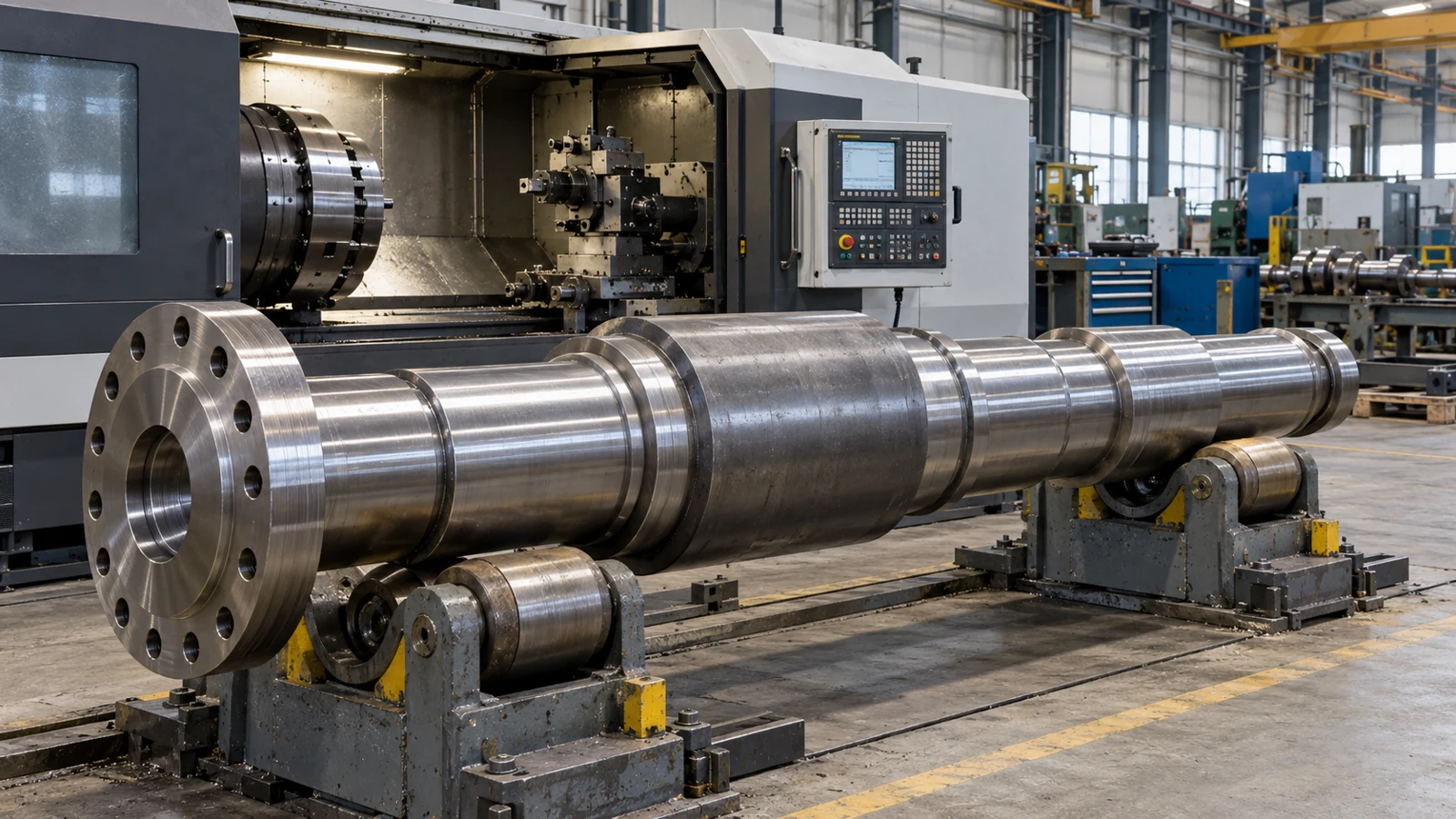
Typical CNC-machined wind-energy components include main shafts, gearbox and bearing housings, hubs, couplings, hydraulic components, generator interfaces, brake components, and parts used in pitch and yaw mechanisms.
Main Shafts and Bearing Journals
A wind-turbine shaft may appear geometrically simple because much of the part is rotational. In practice, long shafts are difficult because the important dimensions are related over considerable distances.
The process may begin with rough turning to establish the main geometry. If heat treatment is required, it is often performed before the final dimensional operations because thermal processing can move the part. Finish turning then restores the major diameters and shoulders, while keyways, flange holes, or other non-rotational features may be milled afterward.
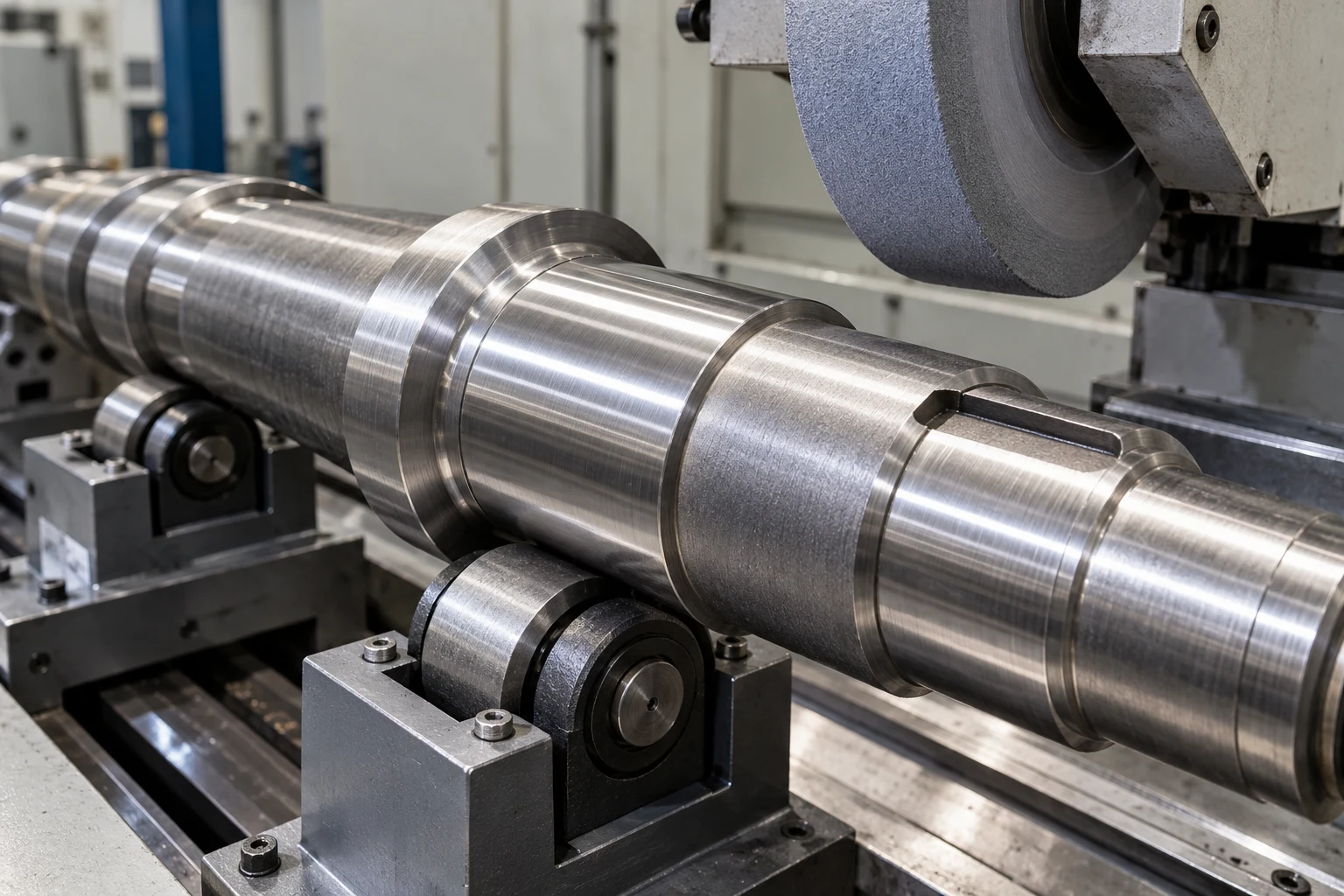
Critical bearing journals can then be cylindrical ground to achieve the required diameter, roundness, cylindricity, and surface condition. Final inspection focuses not only on each journal individually, but on runout and coaxiality relative to the complete shaft axis.
That process chain shows why renewable-energy CNC work often involves several manufacturing methods rather than one machine.
Bearing and Gearbox Housings
Large wind housings introduce a different challenge. A heavy casting may contain several bearing bores that need to remain aligned relative to one another after substantial material removal.
The difficulty is not simply boring one accurate diameter. The entire housing must remain stable while the bores, flange faces, mounting surfaces, and other references are finished.
Fixture design, thermal stability, machine travel, lifting capacity, and inspection capability all become part of the production plan. A large housing that moves slightly after rough machining may require staged finishing rather than completing every critical feature immediately.
Pitch and Yaw Systems
Pitch mechanisms adjust blade angle, while yaw systems keep the turbine oriented toward the wind. Both systems contain moving mechanical assemblies that may rely on machined housings, gears, shafts, bearing interfaces, and hydraulic components.
These parts experience repeated movement throughout the service life of the turbine. Wear resistance, fatigue behavior, alignment, and surface condition can therefore matter more than very tight general tolerances across the entire part.
The machining strategy should concentrate precision where it affects movement and load transfer.
DOE background on composite blade manufacturing.
CNC Machining for Solar Tracking Systems
Solar energy is often treated as if the mechanical structure were secondary to the photovoltaic panel, but utility-scale and tracking installations contain significant mechanical systems.
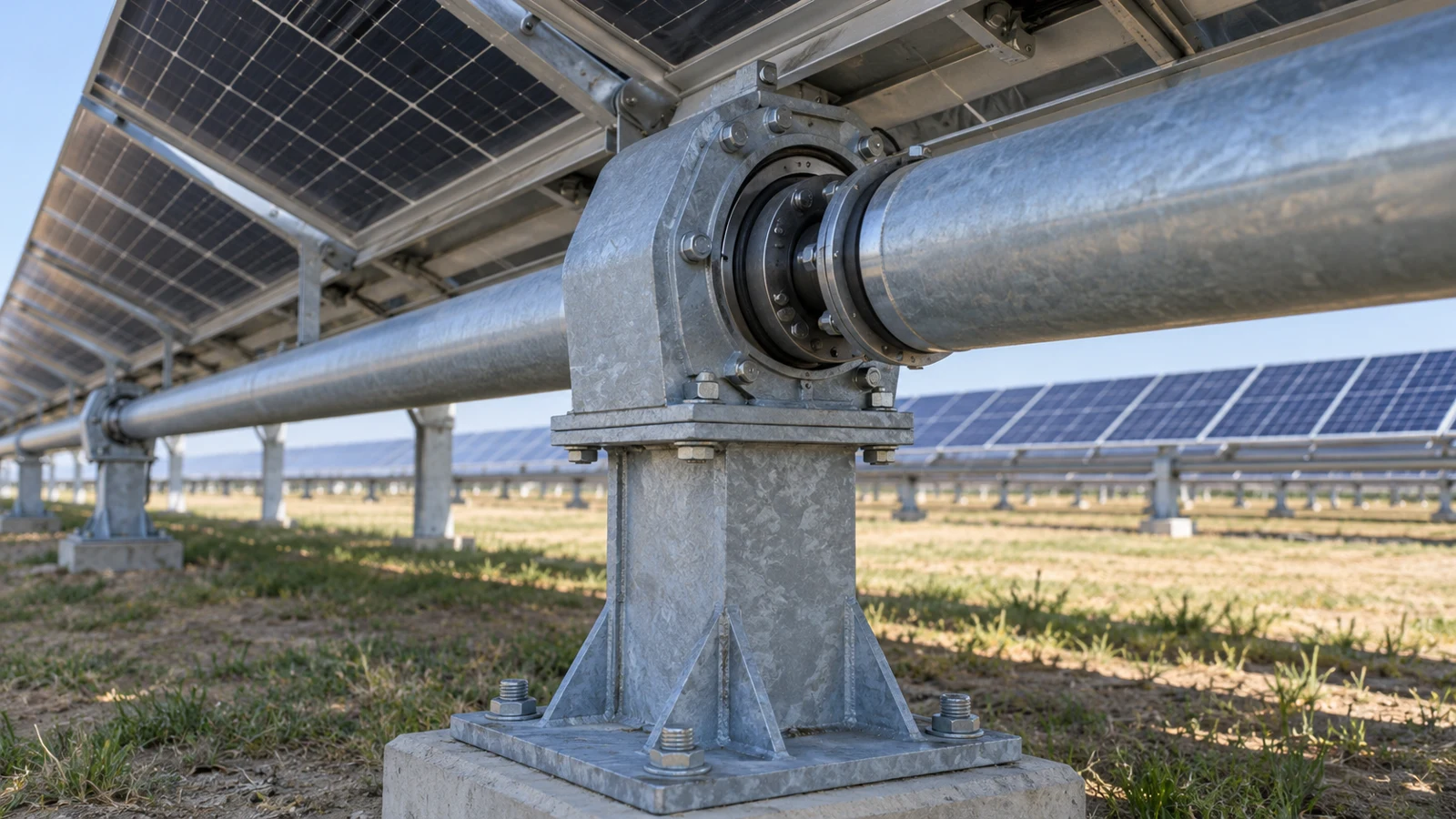
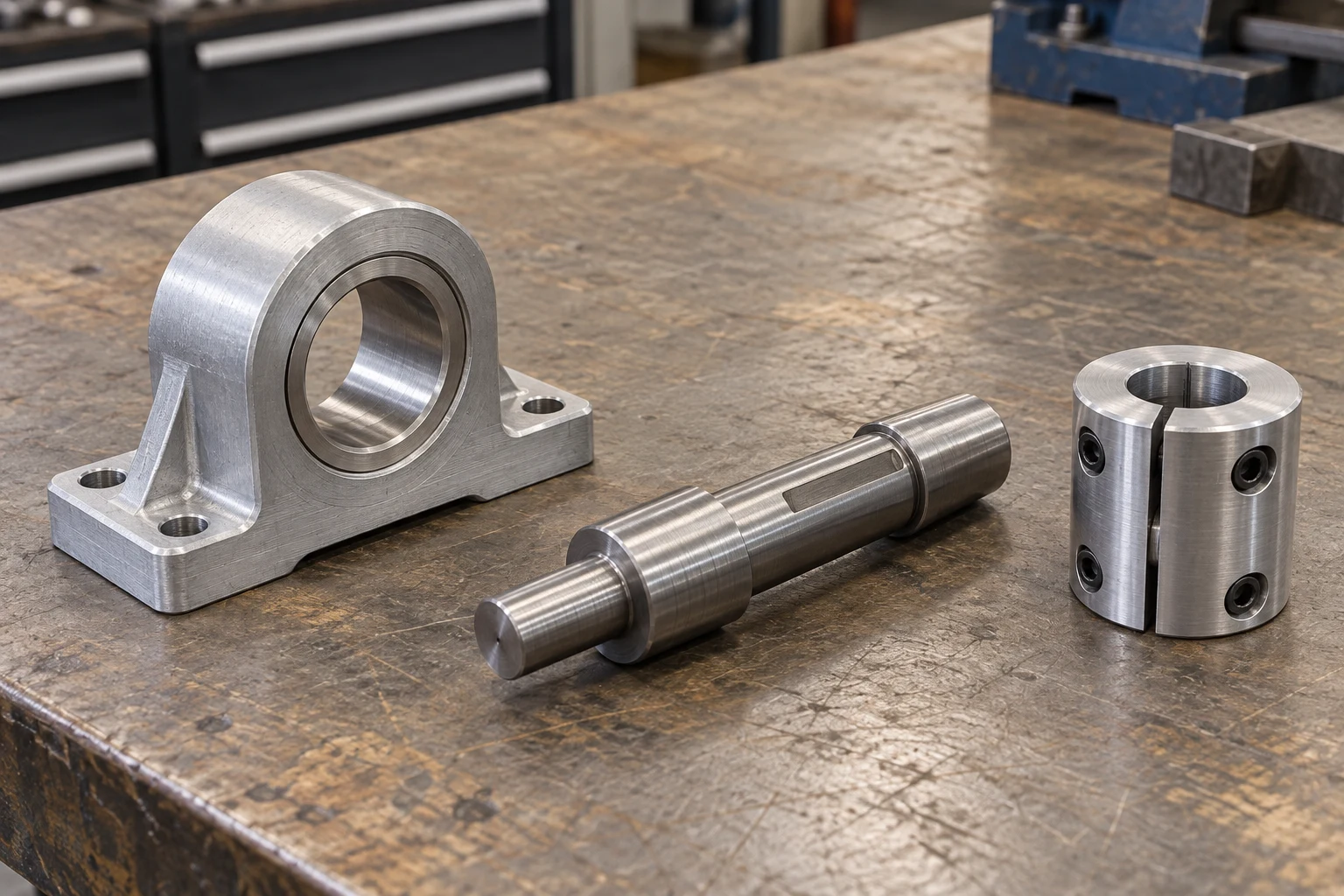
Single-axis and dual-axis trackers use shafts, bearings, actuator mounts, gearbox interfaces, couplings, sensor brackets, and structural connections to reposition panels over time. These parts operate outdoors and need to maintain alignment while exposed to dust, moisture, temperature changes, and repeated movement.
A tracker bearing housing provides a useful example.
The housing may contain one precision bore that controls the shaft and bearing position, several mounting holes that locate the component in the larger structure, and broad exterior surfaces that mainly provide strength. Giving every dimension the same tight tolerance would add cost without improving tracker performance.
A more appropriate machining plan gives the bearing bore and its datum relationship greater control while allowing noncritical external surfaces to use normal production tolerances.
After machining, the housing may receive anodizing, plating, galvanizing, or another corrosion-protection system depending on material and environmental conditions. If the surface treatment adds measurable thickness at the bearing interface, that buildup must be considered during machining.
Actuator and Drive Components
Tracking systems may also use machined shafts, couplings, motor adapters, and gearbox interfaces. These parts frequently combine turning and milling.
A shaft may be turned for bearing and coupling diameters, then moved to milling for flats, keyways, or cross holes. For low-volume or more complex components, mill-turn machining can consolidate those features into fewer setups.
Reducing setups is particularly useful when the relationship between turned and milled features affects final alignment.
CNC Machining for Hydroelectric Systems
Hydroelectric power has many of the same heavy-machining characteristics as conventional power generation. Components are often large, operate continuously around water, and remain in service for decades.
Typical parts include turbine shafts, bearing components, bushings, guide-vane hardware, valve components, housings, and gate-system parts.
Large hydro components may require long-bed turning, boring, milling, grinding, or specialized repair machining. The challenge often lies in maintaining geometry across large distances rather than creating complicated small features.
A long turbine shaft may need bearing journals and sealing regions that remain concentric over a substantial overall length. Supporting the shaft correctly during turning and grinding is essential because its own weight can contribute to deflection.
Hydroelectric plants also create one of the clearest use cases for repair and replacement machining. Equipment may remain in service far longer than the original production supply chain. A plant may eventually need one replacement bushing, two shaft components, or a rebuilt bearing interface rather than thousands of identical parts.
CNC machining is well suited to this situation because it allows very low quantities to be produced without recreating the original high-volume tooling.
On-Site Machining in Hydropower Maintenance
Some hydropower components are simply too large to remove economically for every repair.
Portable machining systems can perform selected operations at the installation site, including flange facing, line boring, journal restoration, and large-hole machining.
The decision between factory machining and on-site machining depends on component size, required precision, access, downtime, and the condition of the surrounding equipment. Factory machining provides greater process control, while in-situ machining can avoid major disassembly and transportation.
In large renewable-energy equipment, the repair strategy itself can therefore become part of the manufacturing decision.
CNC Machining for Geothermal Energy
Geothermal systems operate around heat, pressure, minerals, and potentially corrosive fluids. Pumps, valves, flanges, drilling-system components, sensor housings, and sealing hardware may therefore use materials selected primarily for environmental resistance rather than easy machinability.
That creates an important engineering tradeoff.
A standard carbon steel may be inexpensive to machine but unsuitable for the fluid environment. Stainless steel may provide better corrosion resistance but generate more heat and cutting force. Nickel-based alloys may perform better in particularly aggressive or high-temperature conditions but can produce severe tool wear and substantially longer machining cycles.
The machine shop should therefore develop the process around the material required by the system rather than treating machinability as the main material-selection criterion.
A geothermal valve body, for example, may be rough machined first, followed by port drilling, thread machining, internal deburring, and final finishing of the sealing interfaces. The pressure and sealing features receive the greatest process control because those are the areas most directly related to field performance.
CNC Machining for Green Hydrogen Systems
Green hydrogen belongs to renewable-energy manufacturing when hydrogen production is powered by renewable electricity, but its mechanical manufacturing requirements are quite different from those of wind or solar equipment.
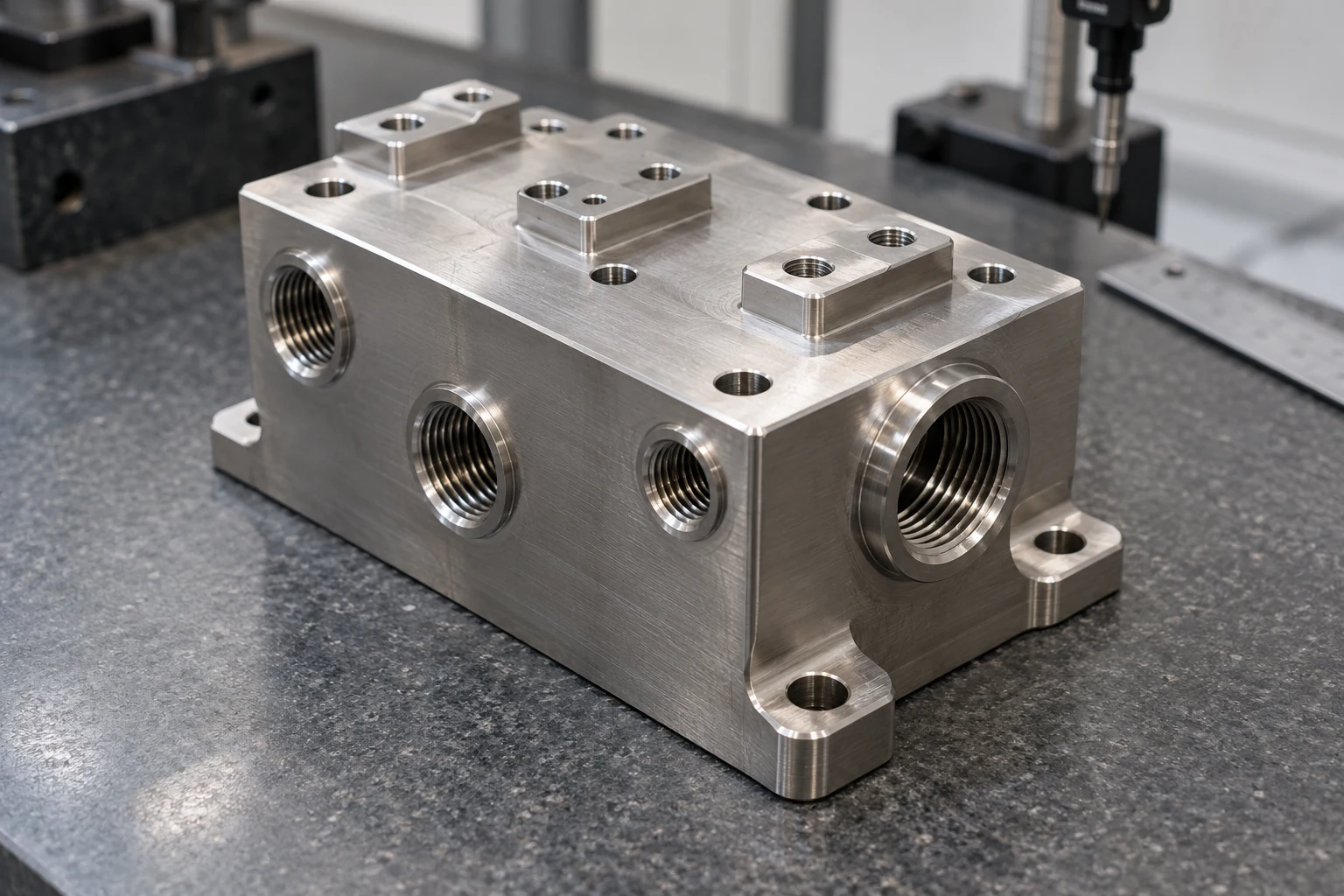
Hydrogen systems may use CNC-machined manifolds, regulators, valve components, compressor parts, sensor housings, test hardware, fittings, and fuel-cell or electrolyzer support components.
A hydrogen manifold is a good example of why small-batch machining can matter during technology development.
Imagine a stainless steel block containing pressure ports, sensor connections, valve interfaces, and multiple intersecting passages. The challenge is not simply drilling the holes. The process needs to maintain the positional relationships between those features while producing reliable threads, protecting sealing surfaces, removing internal burrs, and keeping the finished passages clean.
If testing later shows that one sensor needs to move or the valve arrangement changes, the next batch can be produced from the revised CAD data without creating new casting tooling.
This flexibility is especially valuable during development programs where the mechanical design may change several times before final production.
Sealing and Cleanliness
Hydrogen components may depend on highly controlled sealing interfaces. The exact requirement depends on the seal design, but machining considerations can include surface finish, flatness, thread quality, edge condition, and internal cleanliness.
For pressure manifolds and valves, a burr hidden at the intersection of two drilled passages can be more important than a visible cosmetic mark on the exterior. Internal deburring therefore needs to be treated as a controlled manufacturing operation rather than a final cleanup step.
CNC Machining for Energy Storage and Battery Systems
Energy storage creates another very different class of CNC parts.
Battery packs and power electronics require thermal management, structural support, electrical isolation, and repeatable module assembly. CNC machining is particularly useful during battery development, pilot production, and specialized low-volume systems.
Common parts include cooling plates, module housings, thermal spreaders, busbar fixtures, test plates, structural components, and prototype enclosures.
Battery Cooling Plates
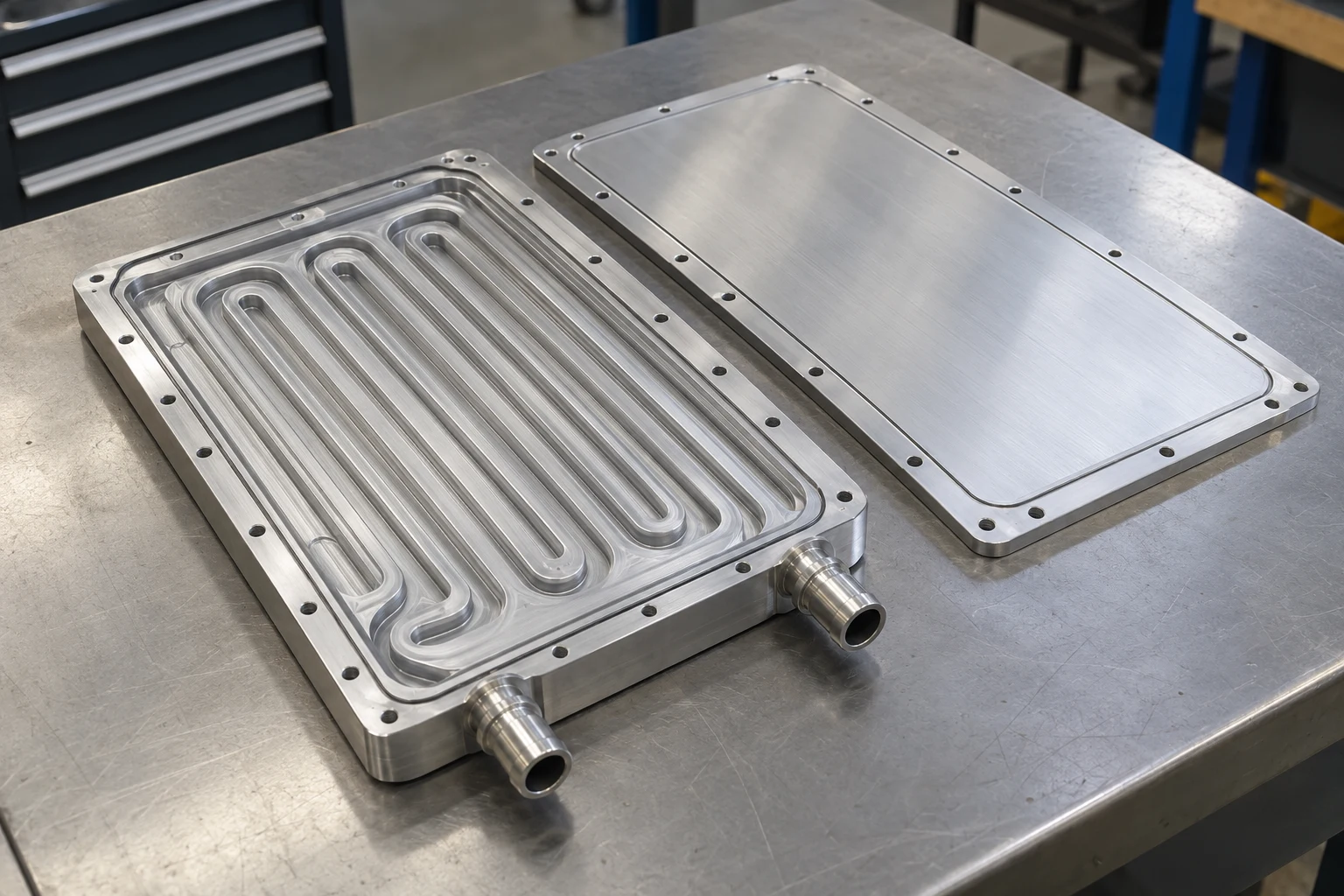
A battery cooling plate may contain coolant channels, connection ports, mounting holes, and sealing grooves in one component.
The process usually begins by machining the bulk geometry while leaving the most critical sealing surfaces for later. Heavy material removal can cause a plate to move slightly as internal stresses are released, so finishing the sealing face too early may result in unnecessary flatness variation after the remaining material is removed.
A better sequence roughs the channels and general geometry first. After the plate has reached a more stable condition, the sealing face and O-ring groove are finished and inspected.
Flatness is particularly important if the cooling plate must contact a battery module or cover uniformly. Groove geometry matters because the sealing system depends on controlled compression rather than simply the presence of an O-ring.
When CNC Is Not the Best Cooling-Plate Process
Not every thermal-management design should be machined from billet.
If the internal channels become very complex or completely enclosed, brazed plates, bonded assemblies, extrusion, casting, or additive manufacturing may provide a better route.
CNC machining may still finish the final ports, sealing surfaces, and mounting interfaces afterward.
This is a recurring theme in renewable-energy manufacturing: the strongest production route often combines near-net manufacturing with precision machining rather than forcing the entire component through one process.
CNC Machining for Renewable-Energy Power Electronics
Renewable-energy systems also contain substantial power-conversion hardware.
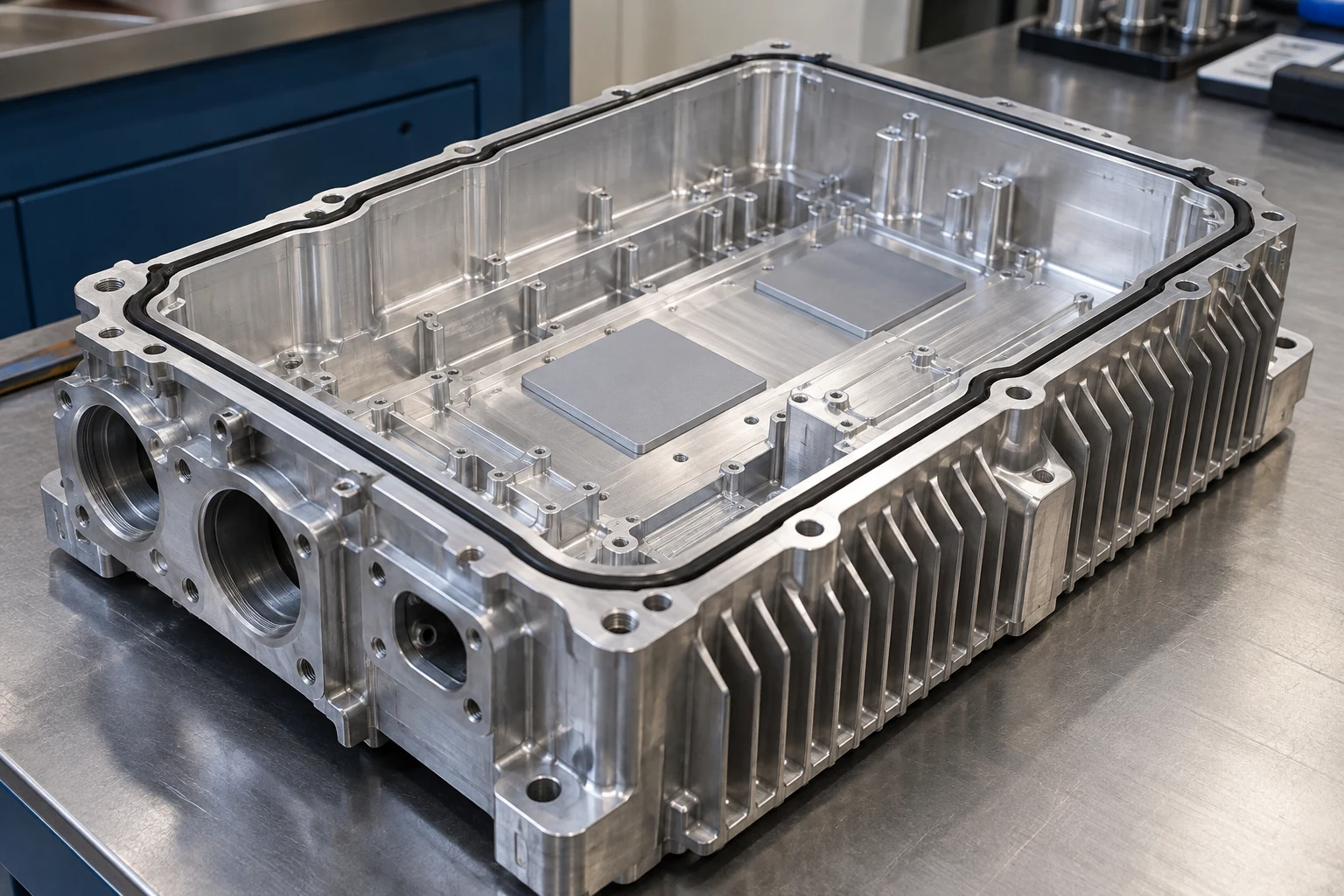
Inverters, motor drives, charging systems, power distribution hardware, and control electronics may require machined aluminum housings, heat spreaders, cooling plates, busbar fixtures, and sealed enclosures.
These components often combine mechanical and thermal requirements.
A machined inverter housing may hold power electronics while also acting as a structural heat sink. Critical surfaces can include thermal interface pads, connector locations, O-ring grooves, grounding areas, and mounting datums.
This creates machining challenges similar to electronics manufacturing but with greater emphasis on power density and environmental exposure.
For prototypes and small production runs, machining the housing from 6061 aluminum allows the electronics team to test real thermal performance before committing to casting or extrusion tooling.
Materials Used in Renewable-Energy CNC Machining
Renewable-energy parts span a wide material range because the service conditions vary so much.
| Material | Typical Applications | Why It Is Used | Main Machining Concern |
|---|---|---|---|
| Aluminum 6061 | Battery plates, control housings, solar hardware | Low weight, machinability, corrosion resistance | Thin-wall distortion, burrs |
| Aluminum 7075 | High-strength lightweight structures | Higher strength | Residual stress and distortion |
| 304/316 Stainless Steel | Hydrogen, geothermal, fluid systems | Corrosion resistance | Heat, tool wear, work hardening |
| 17-4PH Stainless | High-strength valve and mechanical parts | Strength + corrosion resistance | Condition/heat treatment affects machining |
| 4140/4340 Alloy Steel | Shafts, couplings, heavy components | Strength and fatigue performance | Harder condition may require grinding |
| Titanium | Corrosive/high-performance systems | Corrosion resistance, strength-to-weight | Heat concentration and tool wear |
| Nickel Alloys | Severe heat/corrosion environments | High-temperature and corrosion performance | Very difficult machining |
| Copper | Thermal/electrical components | Conductivity | Burr formation and chip behavior |
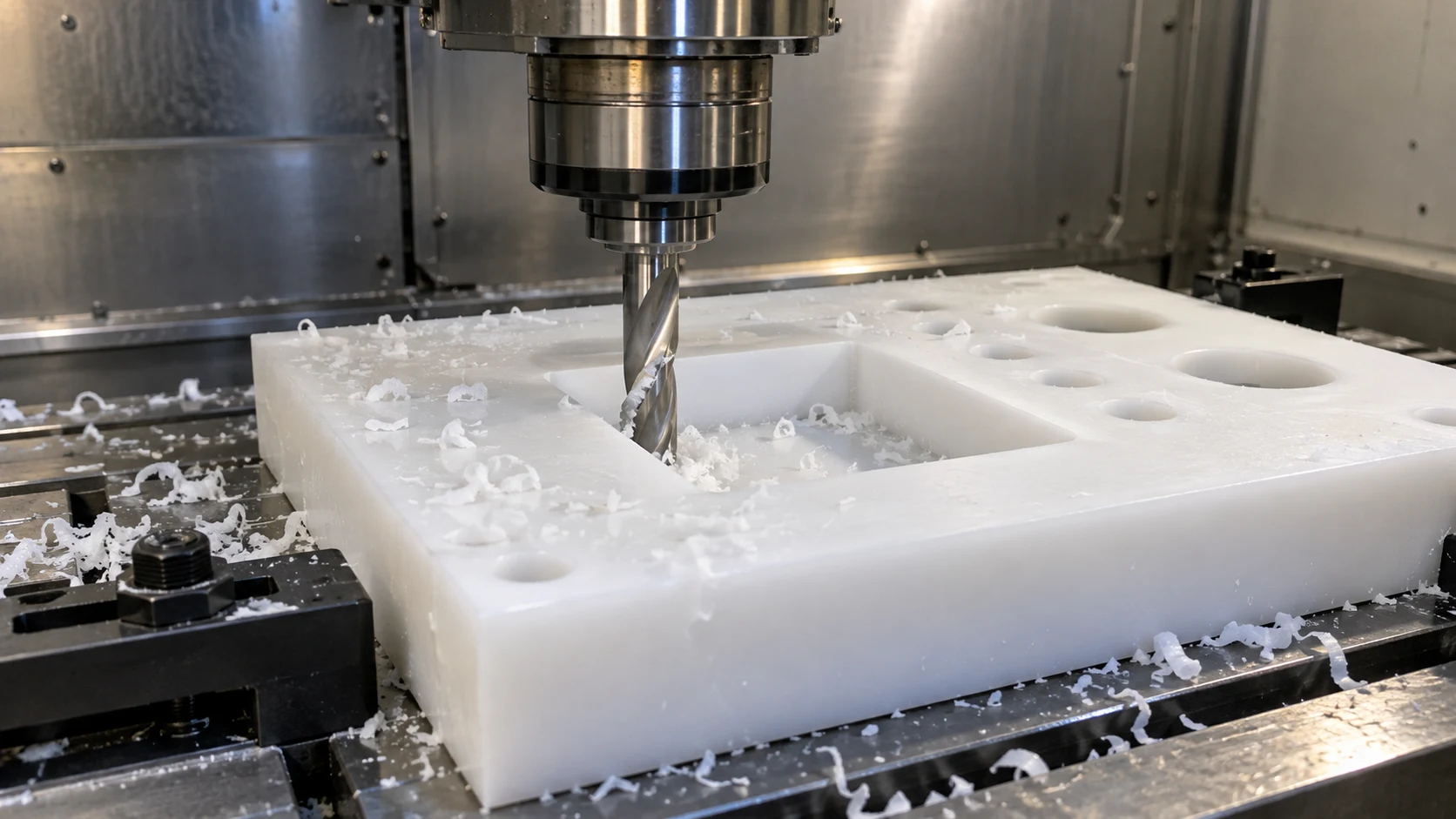
| PEEK / Engineering Plastics | Insulators, fixtures, specialized hardware | Electrical isolation, chemical resistance | Heat and dimensional movement |
The key issue is that material performance and machining cost often move in opposite directions.
A more corrosion-resistant or heat-resistant alloy usually solves a service problem while creating a manufacturing problem. Titanium and nickel alloys are strong examples. The machine shop has to manage cutting temperature, tool life, engagement, and cycle time without compromising the material properties that justified using the alloy in the first place.
Precision in Renewable Energy Means Functional Precision
A common mistake is assuming renewable-energy machining requires every dimension to be extremely tight.
That is rarely the best engineering approach.
A wind bearing housing may contain a critical bore with demanding alignment requirements while several outer dimensions only locate guards or covers. A battery plate may require good flatness and O-ring geometry but have relatively forgiving outer dimensions. A hydrogen manifold may need carefully controlled threads and sealing cones while its outer profile is largely irrelevant.
The drawing should distinguish function-critical dimensions from reference and general geometry.
This reduces machining and inspection cost while focusing process control on the features most likely to affect reliability.
Sealing Surfaces Need Application-Specific Requirements
Renewable-energy fluid and thermal systems use several types of seals, and they should not all be specified in the same way.
An O-ring groove depends on width, depth, compression, edge condition, and an appropriate sealing surface. A flat gasket depends more on flange flatness and the condition of the contact region. Metal-to-metal sealing requires greater control because there is little compliant material available to accommodate local errors.
Mechanical seals can demand an even more controlled surface. In some cases, milling or turning creates the preliminary geometry, followed by grinding or lapping to achieve the final condition.
Surface roughness matters, but a low Ra value alone does not guarantee a good seal. Waviness, tool-mark direction, flatness, and isolated defects also need to be considered.
Large-Part Machining in Renewable Energy
Wind and hydro equipment regularly push CNC machining beyond the dimensions of ordinary prototype work.
Large parts create four additional problems: handling, rigidity, temperature, and inspection.
A heavy casting requires planned lifting and workholding. A large steel housing can change dimension with temperature. Long tools create greater deflection. Measuring a large component accurately can be as challenging as machining it.
This is why machine travel alone is a poor measure of large-part capability.
A component may technically fit inside the machine envelope while still being unsuitable for that machine because the workholding, spindle reach, rigidity, or inspection method is inadequate.
When 5-Axis Machining Matters
Five-axis machining is valuable in renewable energy where the geometry truly benefits from changing tool orientation.
Impellers, turbine-related components, multi-face housings, complex flow surfaces, and some hydraulic components may require access that would otherwise need multiple fixtures or very long cutters.
An impeller illustrates the advantage clearly. Adjacent blades restrict access while each blade changes orientation around the hub. Simultaneous five-axis machining allows the cutter orientation to change continuously, which can improve access and allow shorter, more rigid tooling.
The same process would add little value to a simple solar mounting block that can be machined in two three-axis setups.
Machine selection should therefore follow the geometry rather than the prestige of the machine.
Turning, Mill-Turn and Grinding Remain Equally Important
Renewable-energy marketing often emphasizes advanced five-axis machining, but a large percentage of real energy hardware is rotational.
Shafts, stems, bushings, sleeves, flanges, couplings, and threaded fittings are natural turning components.
Mill-turn machining becomes useful when a rotational component also needs cross holes, ports, flats, keyways, or other milled features. Keeping those operations in one machine can reduce setup error between the turned and milled geometry.
Grinding remains important on hardened shafts, bearing journals, sealing diameters, and precision rotational interfaces. A wind or hydro shaft may therefore spend much more time on a lathe and cylindrical grinder than on a five-axis machine.
Choosing the correct process matters more than maximizing technological complexity.
Repair, Replacement and Reverse Engineering
Renewable-energy assets are long-life systems. As equipment ages, the manufacturing challenge increasingly becomes maintaining existing hardware rather than building only new installations.
Original drawings may be incomplete. Suppliers may no longer exist. A component may have been modified during years of maintenance.
CNC machining provides an effective route for low-volume replacement parts, but reverse engineering needs to go beyond simply copying a worn component.
Suppose an old shaft originally used a 60.00 mm bearing journal but the recovered part measures 59.72 mm after years of wear. Recreating the measured dimension would reproduce the damaged condition rather than restore the original fit.
A proper reconstruction may combine measurements from unworn regions, mating components, old drawings, CMM data, material identification, and engineering judgment.
The objective is to recover the original functional geometry, not the shape created by years of service.
CNC Machining and Sustainability: A More Realistic View
It is tempting to argue that CNC machining is automatically sustainable because it is precise and reduces waste.
The reality is more nuanced.
CNC is a subtractive process, which means material is intentionally removed as chips. Machining a large impeller from solid billet may generate substantial scrap compared with starting from a forging or near-net blank.
The sustainability advantage comes from choosing the manufacturing route intelligently.
Examples include using:
- forgings for large shafts;
- castings for large housings;
- extrusions for constant-section solar or electronics structures;
- additive manufacturing for highly complex internal channels;
- CNC only for the final functional interfaces.
Chip recycling, longer tool life, efficient nesting, reduced scrap, and reliable small-batch manufacturing can also improve resource use.
For prototypes, CNC machining may avoid something even more wasteful: producing dedicated tooling for a design that changes after the first test cycle.
Sustainable manufacturing is therefore less about claiming CNC creates no waste and more about using precision machining where it provides the most engineering value.
Prototype to Small-Batch Production
Renewable-energy technology development often happens in stages.
A hydrogen project may begin with five manifolds, progress to twenty validation units, and later require one hundred pilot-production components. A battery system may test several cooling-plate designs before the final channel configuration is selected. A solar tracking company may build fifty systems before adjusting an actuator interface based on field testing.
CNC machining supports these transitions well because the manufacturing process can change without replacing expensive hard tooling.
The machining strategy itself can also mature as quantity increases.
A prototype may use simple workholding and extensive manual inspection. A 50-piece validation batch may justify dedicated soft jaws and First Article Inspection. A recurring 300-piece order may use multi-part fixtures, probing, controlled tool-life replacement, and defined inspection intervals.
That progression is what turns prototype machining into real small-batch production.
First Article and In-Process Inspection
For renewable-energy components made from expensive material or requiring long cycle times, quality should not depend solely on inspection at the end of the job.
First Article Inspection can confirm that the program, fixture, material, tooling, and inspection method are producing the intended result before the complete batch is released.
In-process inspection is useful where dimensions can drift with tool wear or temperature.
A bearing bore, sealing feature, shaft journal, or pressure interface can be measured periodically during production. If the feature begins trending toward a tolerance limit, the process can be corrected before nonconforming parts accumulate.
Inspection may include CMM, optical measurement, bore gauges, micrometers, surface roughness testing, and machine probing depending on the part.
The important point is not to inspect everything equally. Quality control should focus on the features that determine how the renewable-energy system functions.
DFM Guidelines for Renewable-Energy Parts
Good DFM begins by identifying the functional hierarchy of the component.
A designer should distinguish bearing fits, sealing surfaces, alignment features, and pressure interfaces from dimensions that exist only for assembly clearance or general shape. This makes it easier for the supplier to build a realistic process and quotation.
Deep narrow passages should be avoided unless they are required by the system because they increase tool reach, drilling difficulty, and chip-removal problems. Internal radii should be made as large as function allows so more rigid cutters can be used. Coating buildup should be considered around fits, and drawings should state whether controlled dimensions apply before or after finishing.
Material specifications should also be complete. “Stainless steel” is insufficient if the service environment requires 316, 17-4PH, or another particular grade and condition.
Finally, documentation requirements need to be defined at the beginning. If material certificates, First Article reports, traceability, or specific inspection records are required, they belong in the RFQ.
Practical Example: Wind-Turbine Shaft
Consider an alloy-steel shaft containing several bearing journals, a flange, keyway, and threaded end.
The part is rough turned first to establish the main rotational geometry. Heat treatment is then performed if required by the material specification. Because heat treatment may move the component slightly, finish turning restores the shaft close to final dimensions afterward.
The flange and keyway are then machined relative to the established axis. Critical journals are ground last because the bearing interfaces need controlled roundness, diameter, and surface finish.
Final inspection checks not only individual journal diameters but their runout and coaxiality relative to the complete shaft.
The geometry looks straightforward. The manufacturing sequence is what makes the component accurate.
Practical Example: Green Hydrogen Manifold
A 316 stainless hydrogen manifold contains pressure ports, sensor connections, valve interfaces, and several intersecting internal passages.
Bulk geometry and primary bores are machined first. Ports are drilled and threaded, while care is taken to avoid damaging sealing regions. Internal intersections are then deburred and cleaned because loose material inside the manifold could affect downstream components.
The final machining stage concentrates on sealing interfaces and function-critical features rather than cosmetic surfaces.
After testing, the engineering team moves one sensor port.
The next small batch can be produced from the revised CAD model without casting-tool modification. That ability to change the component between production batches is one of the strongest reasons CNC machining remains important in developing renewable-energy technologies.
Practical Example: Battery Cooling Plate
A machined aluminum cooling plate contains internal coolant paths, connection ports, an O-ring groove, and module mounting holes.
Heavy material removal is completed before the final sealing face is established. This allows the plate to release much of the stress associated with machining before the critical surface is finished.
The O-ring groove and sealing face are then machined, followed by inspection of flatness and groove geometry.
If later thermal testing requires a channel pattern that cannot be reached by conventional milling, the next design may move to a brazed multi-piece plate or an additively manufactured structure while retaining CNC machining for the sealing face, ports, and mounting features.
That is how manufacturing should support engineering rather than constrain it.
Practical Example: Solar Tracker Bearing Housing
A solar tracker housing may contain a bearing bore, actuator mounting interface, bolt pattern, and outdoor-facing external surfaces.
The bearing bore controls shaft alignment, so it receives the greatest dimensional attention. The outer geometry uses more economical tolerances because it mainly provides structure.
After machining, the housing receives an appropriate corrosion-protection finish for outdoor service. If the coating extends into the bearing interface, its thickness needs to be included in the manufacturing allowance.
This kind of tolerance prioritization can reduce cost without sacrificing tracker reliability.
Choosing a CNC Supplier for Renewable Energy
A supplier should be evaluated according to the actual component, not simply whether renewable energy appears on its industry list.
Wind shafts require strong turning and grinding capability. Hydrogen manifolds require reliable milling, internal deburring, material control, and inspection. Battery cooling plates depend more on flatness, sealing geometry, and thermal interfaces. Impellers may require simultaneous five-axis machining.
For projects that move from engineering prototypes into small batches, it is also valuable to work with a supplier capable of changing the manufacturing process as quantity increases rather than treating every order as another prototype.
For 6CNC projects, that may mean combining turning, milling, 5-axis machining, mill-turn, grinding, Wire EDM, and dimensional inspection according to the component rather than forcing every part through one standard process. The same approach applies to material choice and quality documentation: inspection and traceability are applied where the drawing and application actually require them.
Final Thoughts
Renewable-energy manufacturing is not one machining market.
Wind equipment, solar trackers, hydropower, geothermal systems, green hydrogen, batteries, and power electronics all create different manufacturing problems.
What they share is the need for mechanical hardware that continues to function reliably under real service conditions.
A wind shaft needs stable rotational geometry. A hydrogen manifold needs reliable sealing and clean internal passages. A battery cooling plate needs flatness and leak-resistant coolant interfaces. A geothermal valve needs a material that survives the environment even if that material is expensive to machine.
The role of CNC machining is therefore not simply to make renewable-energy parts “precise.”
It is to apply precision where the system actually needs it.
That may mean finishing the critical faces of a casting, grinding a bearing journal after heat treatment, machining a prototype from billet before tooling exists, or producing ten replacement components for equipment that has been in service for twenty years.
For prototypes and small-batch renewable-energy projects, CNC machining offers another important advantage: engineering teams can continue changing the design without committing too early to expensive production tooling.
If you are developing components for wind, solar tracking, hydropower, geothermal, green hydrogen, battery systems, or renewable-energy power electronics, send 6CNC your CAD files, controlled drawings, material requirements, quantity, and inspection requirements.
Upload Your CAD Files → Request a Renewable Energy CNC Machining Quote
Frequently Asked Questions
How is CNC machining used in renewable energy?
CNC machining is used to produce and finish shafts, bearing housings, valve bodies, manifolds, cooling plates, couplings, actuator components, pump parts, impellers, fixtures, and other precision mechanical hardware used in renewable-energy systems.
Which renewable-energy sectors use CNC machining?
Common applications include wind, solar tracking, hydropower, geothermal systems, green hydrogen, battery energy storage, and renewable-energy power electronics.
Is CNC machining used to manufacture wind-turbine blades?
Composite wind-turbine blades are generally produced using specialized composite manufacturing processes rather than conventional CNC machining. CNC machining is much more important for the turbine’s shafts, housings, hubs, pitch and yaw components, drivetrain hardware, and tooling.
Why is CNC machining useful for green hydrogen systems?
Hydrogen equipment often requires low-volume precision manifolds, valves, sensor interfaces, compressor parts, and pressure components. CNC machining allows port and sealing geometry to be changed between development batches without dedicated casting or molding tooling.
What materials are commonly CNC machined for renewable-energy parts?
Common materials include aluminum, carbon and alloy steels, stainless steel, titanium, nickel-based alloys, copper, and engineering plastics. Material selection depends on corrosion, temperature, mechanical loading, electrical requirements, and weight.
Can CNC machining be used for battery cooling plates?
Yes. CNC machining is well suited to prototype and low-volume cooling plates with accessible channels, sealing grooves, mounting features, and thermal interfaces. More complex enclosed channels may favor brazing, bonded construction, or additive manufacturing.
Why is grinding used on wind and hydro shafts?
Grinding can provide better control of bearing-journal diameter, roundness, cylindricity, and surface finish after turning and heat treatment.
Does every renewable-energy component require tight tolerances?
No. Tight tolerances should be concentrated on function-critical features such as bearings, seals, pressure interfaces, rotating surfaces, and alignment features. General structural surfaces can often use more economical tolerances.
Can old renewable-energy components be reverse engineered?
Yes. However, the process should reconstruct the original functional geometry rather than simply duplicate the dimensions of a worn component.
Is 5-axis CNC machining necessary for renewable-energy parts?
Only for certain geometries. Impellers, turbine-related surfaces, complex flow parts, and multi-face components may benefit from five-axis machining. Shafts, flanges, valve bodies, and many housings are more efficiently produced using turning or 3-axis machining.
Can CNC machining support both prototype and small-batch renewable-energy production?
Yes. This is one of its main advantages. The same component can move from a few engineering prototypes into dozens or hundreds of parts while the fixture, inspection, and tool-control strategy becomes progressively more production-oriented.
What should I provide when requesting a renewable-energy CNC machining quote?
Provide the 3D CAD model, controlled engineering drawing, exact material and condition, quantity, surface-treatment requirements, critical tolerances, GD&T, inspection requirements, and any material-certification or traceability requirements.