The Strategic Importance of Material Selection in 2026
Choosing the wrong CNC material doesn’t just slow down production — it can make tight tolerances physically impossible to achieve. As industrial part complexity increases, material selection has become the primary limiting factor separating successful high-tolerance builds from costly rework cycles.
Metals consistently outperform plastics for precision work, often achieving accuracies below ±0.005 mm due to superior structural rigidity. That single data point shapes every material decision in a serious machining workflow.
Key shifts driving smarter material choices in 2025:
- Prototyping-to-production convergence — teams now expect prototype materials to carry directly into low-volume production runs without re-qualifying
- Machinability-first evaluation — hardness, thermal stability, and chip behavior are scored before price
- Tolerance traceability — aerospace, medical, and defense buyers demand full material certifications at the quote stage
- Setup efficiency — multi-axis capabilities like simultaneous 5-axis cutting reduce fixturing errors that materials with poor rigidity amplify
High-tolerance work demands a framework that evaluates every candidate material through the lens of real machining performance — not just cost. The eight materials ahead are ranked exactly that way.
When precision is non-negotiable, material selection is the decision that determines everything else.
1. Aluminum 6061-T6: The Industrial Workhorse
When engineers evaluate CNC machining materials for high-tolerance industrial parts, Aluminum 6061-T6 consistently rises to the top. It’s the most widely used material for general automotive and aerospace components — and for good reason. According to Brightstar CNC, its dominance comes from a rare combination of strength, corrosion resistance, and cost-effectiveness that few alternatives can match.
Key technical specifications:
- Tensile strength: 45,000 psi
- Machinability rating: ~95% (relative to free-machining brass)
- Operating RPM range: 8,000–15,000 RPM in high-speed CNC operations
- Achievable surface finish: Ra 0.4 µm with proper tooling and feed rates
- Density: 0.098 lb/in³ — lightweight without sacrificing structural integrity
Here’s why it excels across demanding use cases:
- Select it for structural housings and brackets where weight-to-strength ratio is critical.
- Optimize spindle speeds between 10,000–15,000 RPM to minimize heat buildup and extend tool life.
- Apply fine finishing passes to consistently hit Ra 0.4 µm tolerances on visible or mating surfaces.
- Leverage its weldability and anodizing compatibility for aerospace structural parts requiring post-process treatment.
For complex geometries, pairing 6061-T6 with advanced multi-axis setups unlocks even tighter tolerances with fewer setups.
Application callout: Aerospace brackets, electronic housings, automotive suspension components, and medical device frames.
If budget, machinability, and performance all matter — and they usually do — 6061-T6 is the logical starting point before considering specialized materials like stainless steel.
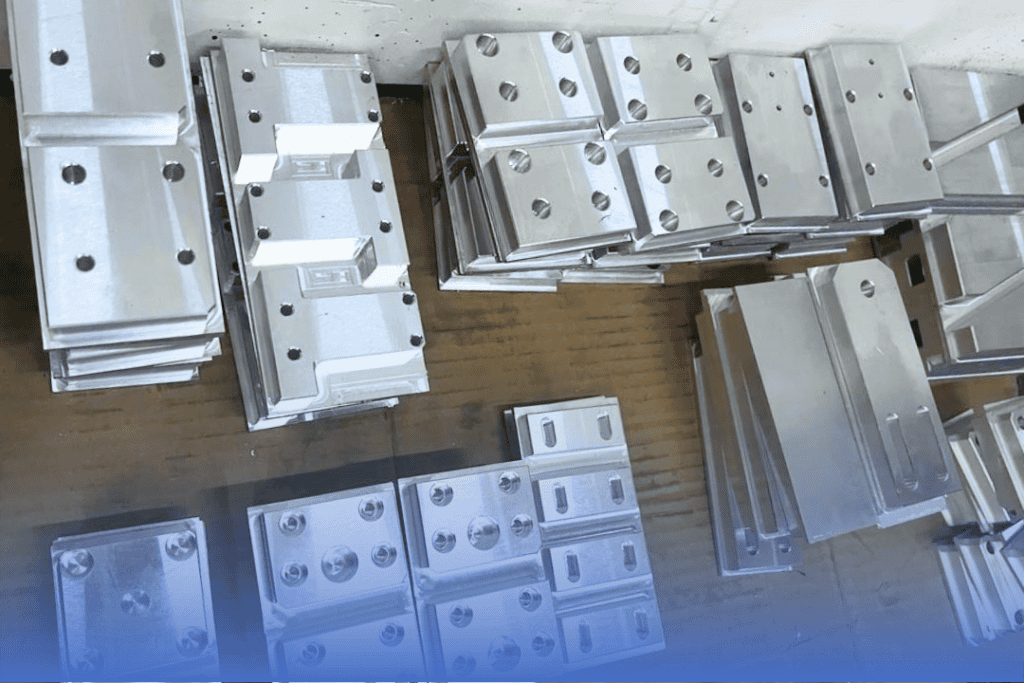
2. Stainless Steel 304 & 316: Corrosion Resistance at Scale
Where aluminum 6061-T6 dominates for lightweight applications, stainless steel earns its place when corrosion resistance and thermal stability are non-negotiable. As Xometry notes, 304 stainless is widely stocked and delivers reliable performance for fast-turnaround projects — making it a go-to for general industrial components.
Grade selection comes down to environment:
- 304 stainless — ideal for food processing, structural parts, and general manufacturing where standard corrosion resistance suffices
- 316 stainless — preferred for marine, chemical, and medical applications due to its molybdenum content, which blocks chloride-induced pitting
Work hardening is the most critical challenge. Stainless steel hardens rapidly during cutting, accelerating tool wear and threatening dimensional accuracy. Sharp tooling, controlled feed rates, and consistent coolant flow are essential — particularly when targeting tolerances under ±0.005 mm.
One practical advantage over aluminum is thermal stability. Stainless steel’s lower thermal expansion coefficient holds dimensions more predictably across temperature swings, a meaningful benefit for parts used in high-heat environments. For complex geometries, pairing stainless with precision multi-axis setups reduces repositioning errors that compromise tight tolerances.
| Property | 304 Stainless | 316 Stainless |
|---|---|---|
| Corrosion resistance | Good | Excellent |
| Best environment | General industrial | Marine/medical |
| Machinability | Moderate | Slightly harder |
| Relative cost | Lower | Higher |
For projects demanding an even greater strength-to-weight ratio than stainless can offer, titanium CNC machining becomes the logical next step — though it introduces a new set of thermal and tooling challenges.
Choose 304 for cost-effective general use; upgrade to 316 whenever chloride exposure or biocompatibility requirements enter the picture.
3. Titanium Grade 5: The High-Performance Choice
Titanium Grade 5 (Ti-6Al-4V) stands apart as a cnc machine material when part performance is non-negotiable. Its strength-to-weight ratio exceeds both aluminum and stainless steel, while its biocompatibility makes it the default choice for orthopedic implants, spinal hardware, and aerospace structural components. The global aerospace CNC machining market is projected to grow at a CAGR of 7.2% through 2033, largely driven by titanium adoption — a figure that reflects just how critical this alloy has become.
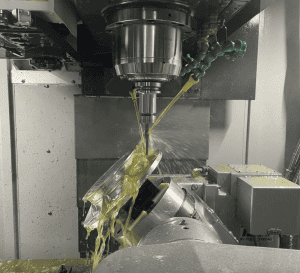
The challenge is thermal management. Titanium’s low thermal conductivity traps heat at the cutting edge rather than dispersing it through the workpiece, accelerating tool wear and risking dimensional distortion during 5-axis milling.
“Titanium forces you to slow down — aggressive feed rates cause work hardening almost immediately.”
“Hitting ±0.005 mm tolerances on titanium requires real-time spindle load monitoring, not just a good setup.”
“Coolant strategy on titanium isn’t optional — it’s the difference between a good part and a scrapped one.”
Because of these complexities, low-volume titanium runs carry significant per-part costs — tooling and cycle time dominate the budget.
If your part demands extreme strength with minimal mass, titanium earns every dollar — but plan your budget and supplier selection carefully.
4. Copper and Brass: Conductivity and Machinability
Copper cnc machining and brass work occupy a specialized niche — these metals shine in electrical, thermal, and fluid power applications where conductivity or ultra-smooth machinability is the priority.
Copper C101 delivers near-perfect electrical and thermal conductivity, making it the default choice for busbars, heat sinks, and RF shielding components. However, its notorious “gumminess” creates real process challenges:
- Chip evacuation is poor — long, stringy chips wrap around tooling and accelerate wear
- Specialized cooling strategies are essential during high-speed turning to prevent tool deformation from heat buildup
- Slower feed rates and sharp, polished tooling are typically required to maintain tolerances
Brass C360, on the other hand, is the industry benchmark for machinability — rated at 100% on the standard machinability index. It cuts cleanly, produces short chips, and tolerates high spindle speeds with minimal tool wear. In practice, brass is the preferred material for fluid power fittings, valve bodies, and precision fasteners where tight tolerances meet high production volumes. Selecting a capable machining partner for tight specs matters significantly with both materials.
Choose copper C101 when conductivity is non-negotiable, and brass C360 when you need fast, cost-efficient precision — then consider whether your application demands something that metals simply can’t deliver.
5. PEEK and POM: High-Performance Engineering Plastics
When metal isn’t the answer — due to weight, chemical exposure, or electrical isolation requirements — engineering plastics become two of the best CNC materials for precision machining. PEEK (polyether ether ketone) and POM (Delrin) each solve distinct problems in demanding industrial environments.
PEEK handles continuous service temperatures up to 480°F and resists aggressive chemicals, making it the go-to for aerospace bushings, medical implants, and semiconductor components. As Xometry notes, for high-wear parts like bushings and sliding components, prioritizing hardened materials such as PEEK avoids premature failure.
POM (Delrin) excels where PEEK’s cost is hard to justify. Its low coefficient of friction makes it ideal for gears, cams, and linear guides that demand smooth, repeatable movement.
The critical challenge with both materials is thermal expansion and flex. Plastics move dimensionally as temperatures shift, which can invalidate tight tolerances after machining.
💡 Tip: Always specify stress-relieved stock for precision plastic components. Annealing before machining releases internal stresses that would otherwise cause post-machining warping — particularly important for complex geometries achievable through multi-axis cutting approaches.
When specifying engineering plastics, always confirm stress relief and thermal stabilization before committing to a final tolerance.
Key Takeaways: Selecting for Precision and ROI
After walking through metals, alloys, and engineering plastics, the decision framework ultimately comes down to four practical filters — cost, tolerance, availability, and wear.
- Prioritize 6061-T6 for cost-to-precision balance. Across most structural and enclosure applications, 6061-T6 aluminum delivers tight tolerances at a lower material and cycle-time cost than titanium or stainless steel. It’s the default starting point for most prototyping materials for CNC milling projects before committing to a pricier alloy.
- Use metals when tolerances drop below ±0.005 mm. While high-precision CNC services can reach ±0.0025 mm, material choice is the primary limiting factor. Engineering plastics creep under load; metals hold geometry at the interfaces that matter most.
- Material availability drives lead time. A technically superior alloy sitting on a six-week backorder can stall a production run. Confirm stock before finalizing a material spec — especially for low-volume or single-unit builds.
- Match hardness to wear cycle. A soft alloy in a high-friction bore will fail prematurely, regardless of how tight the initial tolerance was. Always cross-reference Brinell hardness against the expected contact stress.
Before locking in a material, run each candidate through all four filters — the right choice balances every dimension, not just one.
Conclusion: Bridging Prototyping and Production with 6-cnc
Material selection doesn’t end at a spreadsheet — it ends at a finished, inspected part that meets your drawing’s requirements. From aluminum alloys and titanium to PEEK and POM, every material covered in this guide demands a machining partner with the equipment and process discipline to hold tolerances consistently, not just occasionally.
That’s where scale and specialization matter. With 140+ advanced machines and over a decade of precision manufacturing expertise, 6-cnc delivers tight tolerances — down to ±0.005 mm — across all the materials discussed here. That capability spans both 5-axis milling and turning, eliminating the handoffs and setups that introduce error.
In practice, the most costly mistakes happen after design is frozen. Engaging machining experts during the design phase — before drawings are released — allows for material swaps, feature adjustments, and tolerance relaxations that save real money at scale.
Whether you’re prototyping a single component or scaling toward production volumes, the right partner shortens that path significantly. Request a custom quote and get expert input on your material and tolerance stack before cutting a single chip.
Start the conversation early — the design phase is always cheaper than the rework phase.

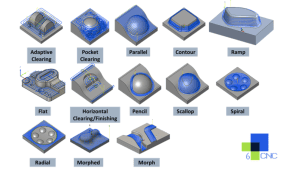
![Comparison of Operating Principles: This figure illustrates a microscopic comparison of the surface waviness and residual scallop height generated by a face milling cutter and a ball-nose cutter under different stepover and step-down settings. [Figure 4-1]](https://6-cnc.com/wp-content/uploads/2026/06/image-2-300x199.png)