A part that needs five setups on a 3-axis mill rarely stays cheap for long. Every extra setup adds labor, fixture cost, stack-up error, and inspection time. That is the real question behind is five axis machining worth it – not whether the machine looks advanced, but whether it reduces total project cost and risk for your specific geometry.
For many buyers, 5-axis is worth it when the part is complex, tolerance-sensitive, or tied to a tight delivery window. For others, it is unnecessary overhead. We see both cases. The right answer depends on how many faces need machining, how strict the positional tolerances are, what surface finish matters, and whether you are buying one prototype or repeating small batches over time.
When is five axis machining worth it?
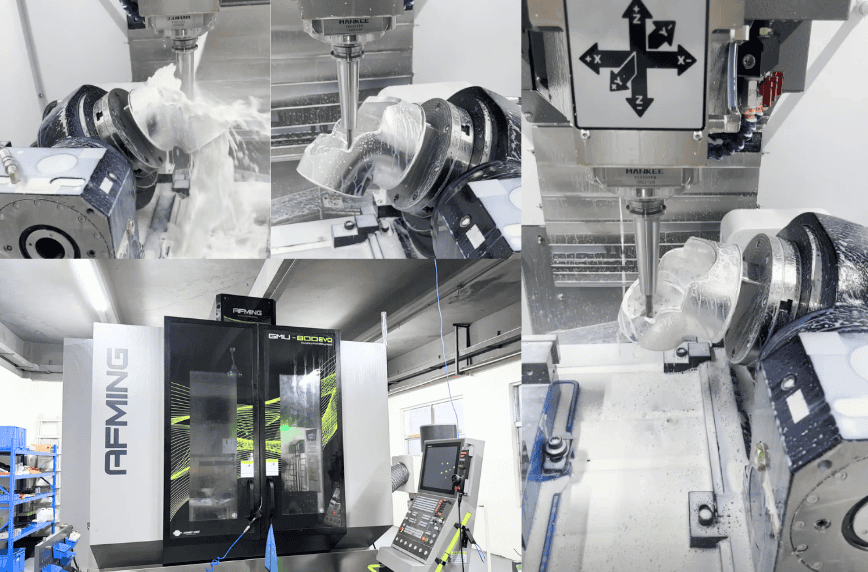
Five-axis machining becomes worth the premium when it replaces multiple operations with one controlled process. A 5-axis machine moves the cutting tool or part across five axes at once or in indexed positions. That allows access to more surfaces in a single setup and often reduces the need for custom fixtures.
The business impact is straightforward. Fewer setups usually mean lower cumulative labor, fewer opportunities for datum transfer error, and faster progression from raw stock to finished part. If your team is fighting tolerance drift between operations, five-axis often solves a cost problem that does not appear on the initial machine-hour quote.
This matters most for parts with deep cavities, angled features, compound curves, undercuts, or hole patterns on several faces. Aerospace brackets, impellers, medical components, robotics housings, and precision automation parts are common examples. These parts are not difficult only because of shape. They are difficult because each repositioning step increases the chance of inconsistency.
The cost question buyers actually need answered
Many shops present 5-axis as a premium process and stop there. That framing is incomplete. Hourly machine rates are higher, but part cost does not always rise.
A 3-axis process may require three fixtures, four setups, and manual re-alignment after each operation. A 5-axis process may cut the same part in one or two setups. If that change removes 2 to 4 hours of setup labor, eliminates a dedicated fixture, and shortens inspection, the final quoted price can be equal or lower.
The break-even point usually appears when part complexity rises. On simple prismatic parts with top-down milling and a few side features, 3-axis or 4-axis indexed machining is often the better value. On parts with many angled surfaces or tight true-position requirements across multiple faces, 5-axis becomes easier to justify.
Material also changes the equation. In titanium, Inconel, hardened stainless, and high-value aluminum billets, better tool access can improve cutting conditions and reduce scrap risk. That matters because one scrapped part in an expensive material can erase any apparent savings from choosing a cheaper process plan.
Where five-axis delivers measurable value
The first gain is setup reduction. Each setup creates a new opportunity for error. Even with careful probing and quality fixturing, moving a part from one orientation to another introduces variation. If your drawing calls for tight relationships between features on different faces, one-setup machining protects those relationships.
The second gain is better geometry control. Five-axis toolpaths can keep the cutter at a more favorable angle to the surface. That helps on contoured forms, blisks, impellers, ergonomic housings, and optical or fluid-path components. You get smoother blending and often less hand finishing.
The third gain is shorter lead time on difficult parts. This does not mean every 5-axis job ships faster than every 3-axis job. It means complex parts move through production with fewer process handoffs. Less fixture design, fewer re-clamps, and less manual intervention can compress schedules, especially for prototypes and low-volume runs.
The fourth gain is fewer special fixtures. Complex fixturing costs money and takes time to build, verify, and maintain. If 5-axis access lets us hold the part securely once and machine most features from that position, you avoid non-recurring costs that make low-volume production unattractive.
When five-axis is not worth it
Not every part benefits. A flat plate with pockets, drilled holes, and basic side features does not need simultaneous 5-axis machining. Using it there may only increase programming time and machine rate.
It may also be unnecessary for high-volume parts that already run well in dedicated fixtures on 3-axis or transfer-style operations. Once a stable production process exists, switching to 5-axis does not automatically improve economics.
Tolerance requirements matter too. If your print allows generous tolerances and the geometry is simple, a more basic process often wins. Paying for advanced capability without a measurable reduction in risk or cycle time is not efficient purchasing.
There is also a programming factor. Five-axis CAM requires stronger process planning. A good shop will account for collision avoidance, tool reach, holder interference, machine kinematics, and workholding stability. If the supplier lacks deep 5-axis experience, the theoretical advantage can disappear quickly.
Is five axis machining worth it for prototypes?
For prototypes, the answer is often yes if the part geometry is close to the final production design. A 5-axis process can produce a more representative part without simplifying features just to fit a lower-capability machine. That helps your team validate assembly, fit, airflow, fluid dynamics, or real-world performance earlier.
Prototype value is not only about speed. It is about avoiding design decisions based on a compromised sample. If the end-use part needs compound surfaces, angled bores, or hard-to-reach features, machining it correctly from the start reduces engineering rework later.
We often advise buyers to compare the full prototype path rather than the first quote line. A cheaper part that requires design concessions, extra bench work, or a second prototype cycle is usually not the cheaper option.
How to decide part by part
Start with setup count. If your part needs more than two or three setups on a conventional mill, five-axis deserves serious review. Next, look at tolerance relationships across faces. If flatness, perpendicularity, true position, or profile must hold through multiple orientations, reducing repositioning is valuable.
Then check feature access. Long tool stick-out, deep pockets, and angled features often signal a 5-axis opportunity. Better tool access can improve finish and reduce chatter. That can directly affect inspection results and part consistency.
After that, evaluate quantity. For one-off parts and low-volume batches, avoiding fixture investment often supports 5-axis. For larger repeat programs, the answer depends on total cycle time, process stability, and amortized tooling strategy.
Finally, compare supplier capability, not just machine type. A strong 3-axis shop can outperform a weak 5-axis shop. Ask how the part will be held, how datums will be controlled, what tolerances are realistic, and whether the process needs custom fixturing or secondary finishing.
A practical rule for buyers
If five-axis reduces setups, protects critical tolerances, and removes fixture complexity, it is usually worth it. If it only adds machine sophistication to a simple part, it usually is not.
That sounds basic, but it aligns with what actually drives cost in precision machining. Labor content, rework risk, scrap exposure, and inspection burden often matter more than the hourly rate printed on a machine list. Buyers who focus only on spindle cost miss where margins disappear.
In our experience, the strongest candidates for 5-axis are low-to-mid volume precision parts with complex geometry and little room for dimensional drift. The weakest candidates are straightforward prismatic parts where 3-axis or 4-axis indexed machining already achieves the print efficiently.
A good manufacturing partner should tell you when not to use 5-axis. That advice saves money and builds a better long-term process. If your supplier recommends five-axis for every part, treat that as a quoting habit, not an engineering decision.
The best question is not whether 5-axis is more advanced. It is whether it helps you ship the right part, on time, without paying for avoidable rework. That is where the value shows up.