

A fast quote only helps if it is accurate. We see this problem often: a buyer needs parts quickly, sends a STEP file with limited notes, gets a low number back, and then loses two days clarifying tolerances, finishes, threads, or inspection requirements. The issue is not speed alone. A useful rapid CNC machining quote must reflect real machinability, realistic lead time, and the quality standard your project actually needs.
For engineers and sourcing teams, quoting speed affects more than convenience. It changes prototype timing, internal approvals, and production risk. If your supplier quotes in hours but misses key details, you often pay later through engineering questions, rework, delayed shipment, or parts that do not pass assembly.

What a rapid CNC machining quote should actually tell you
A serious quote does more than list unit price. It should show whether the supplier understood your part, your quantity, and the manufacturing route required to make it consistently. That matters even more for low-volume and tight-tolerance work, where setup strategy can change cost significantly.
At minimum, you should expect clarity on material, process, quantity, lead time, and any assumptions used during review. If your drawing calls for ±0.01 mm on a cosmetic cover plate, a capable supplier should question that requirement. If your part needs ±0.002 mm on a bearing fit, that tolerance should push the quote toward the right machines, inspection plan, and production time.
This is where many online pricing tools fall short. Automated systems can price simple geometry well, but they often struggle with compound tolerances, critical datums, true position callouts, surface finish zones, or parts that need multiple operations such as milling, turning, grinding, and post-processing. Fast quoting works best when software speed is matched with engineering judgment.
Why rapid CNC machining quote accuracy varies so much
Two suppliers can review the same file and return very different numbers. That does not always mean one is overpriced. It may mean one supplier included the real work and the other did not.
The biggest variable is interpretation. A clean 3D model is helpful, but the drawing still controls many cost drivers. Thread depth, burr requirements, edge break standards, flatness, concentricity, heat treatment, anodizing thickness, and inspection reporting all affect process planning. If those details are missing or unclear, suppliers fill the gaps with assumptions. Those assumptions create quote spread.
Machine capability also changes pricing logic. A shop built around standard 3-axis work may quote a complex housing with several setups, manual repositioning, and higher cumulative error risk. A supplier with 5-axis capability may complete the same part in fewer operations. The quoted price could be lower, or it could be higher but more stable because the process is more repeatable.
Material sourcing adds another layer. Aluminum 6061 is straightforward. Stainless 17-4, titanium, copper, PEEK, or engineering plastics with tight flatness requirements can affect stock cost, tool wear, cutting speed, and scrap risk. A rapid quote that ignores those realities is only fast on paper.
The information that speeds up quote turnaround
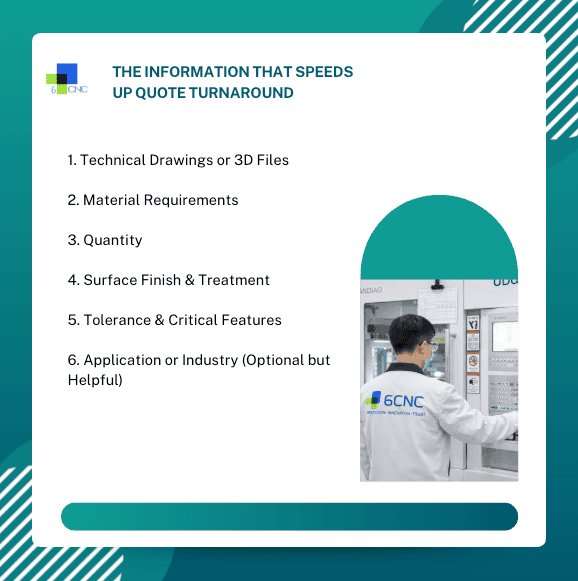
If you want a faster and cleaner result, send a complete package the first time. In our experience, quote delays usually come from missing manufacturing intent rather than part complexity.
Start with the 3D CAD file in STEP or similar neutral format. Add the 2D drawing if dimensions, tolerances, GD&T, or notes matter. State the material grade clearly. Do not write only “aluminum” or “stainless steel” if alloy selection affects function, corrosion resistance, or compliance. Identify quantity by phase if needed, such as 2 prototype parts, 20 pilot units, and 100 production parts.
You should also specify surface finish, color, hardness, and any critical features. If one bore mates with a dowel pin and another is only clearance, say so. That helps the supplier focus process control where it matters instead of inflating cost across the whole part.
Inspection expectations are another common gap. First article inspection, CMM reports, material certificates, RoHS or REACH requirements, and batch traceability all influence quoting. These are not minor add-ons for many B2B projects. They affect routing, documentation, and delivery commitment.
How DFM feedback improves a rapid CNC machining quote
A quote should not be a passive transaction. The best suppliers treat it as the first manufacturing review. That is where DFM feedback becomes valuable.
A small design adjustment can reduce cost and lead time without changing function. Internal corner radii are a classic example. If your pocket requires an unrealistically sharp internal corner, the supplier may need smaller tools, slower feeds, and longer cycle times. Opening that radius slightly often lowers machining time and improves consistency. The same applies to deep narrow slots, unnecessary fine finishes on hidden surfaces, and tolerances that exceed assembly needs.
This is particularly important in prototype and low-volume work. You are not just buying parts. You are buying speed to validation. A supplier that flags manufacturability issues early helps you avoid repeated revisions and compressed test schedules later.
For that reason, the fastest quote is not always the best first response. A quote delivered in a few hours with targeted DFM notes can be more valuable than an instant price with no technical review.
Cost drivers buyers should watch closely
Most CNC quote variance comes from a short list of technical factors. Geometry complexity is one. Thin walls, deep cavities, multiple setups, undercuts, and strict positional tolerances all increase cycle time and inspection effort.
Tolerance strategy is another major driver. Tight tolerances should stay only on functional features. Applying them broadly raises cost fast. The difference between ±0.1 mm and ±0.01 mm can change tool selection, machine choice, and inspection time. At the extreme end, tolerances down to ±0.002 mm are possible for specific features, but they require the right process controls and should be reserved for real engineering need.
Quantity changes pricing in less obvious ways than many buyers expect. For very low quantities, setup and programming dominate cost. For small batches, fixture design, tool life, and process repeatability become more important. The cheapest prototype route may not be the best path for 50 or 200 parts. A good quote should reflect where your order sits on that curve.
Finishing and secondary operations often surprise first-time buyers. Anodizing, black oxide, passivation, bead blasting, engraving, assembly, and precision grinding each add time, logistics, and inspection requirements. If your timeline is tight, these steps can matter as much as machining itself.
How to compare quotes without creating risk
It is tempting to compare by piece price alone. That works only when every supplier quoted the same scope, quality level, and delivery condition. In practice, they rarely do.
Read the assumptions carefully. Check whether material grade is identical, whether finish is included, whether shipping is included or excluded, and whether the lead time starts from PO date, drawing approval, or material arrival. Confirm whether inspection documents are included. A lower quote can quickly become the higher total cost once exceptions start appearing.
You should also look at process fit. If a supplier asks intelligent questions about datums, assembly interfaces, or non-critical tolerances, that is usually a good sign. It shows they are thinking beyond price and toward manufacturable output. For industrial buyers, that reduces downstream risk more than a small difference in unit cost.
At 6 CNC, we have found that the most effective quoting conversations happen when engineering and purchasing align early. The engineer defines what matters functionally. The buyer defines timing, target quantity, and commercial constraints. That combination produces faster approvals and fewer revisions.
When a rapid CNC machining quote is the right approach
Rapid quoting is especially useful when you are in prototype validation, bridge production, fixture development, or replacement part sourcing. These situations need quick decision-making, but they also punish bad assumptions. A wrong tolerance, an omitted finish, or an unrealistic due date can stop assembly or field deployment.
It is less effective when the RFQ package is still fluid. If your drawing is not released, your material choice is undecided, or your tolerance scheme is still under review, the quote will likely move. In that case, ask for a budgetary quote first and identify open items clearly. That keeps expectations realistic.
The best outcomes come from a simple principle: speed should compress waiting time, not compress engineering review. When a supplier can review files quickly, flag manufacturability concerns, and return a quote built on actual process capability, you gain something more useful than a number. You gain a clearer path to getting the part made right the first time.
If you need a rapid CNC machining quote, send enough information for the supplier to quote the part you need, not the part they have to guess at. That one step usually saves more time than any software ever will.